Christmas Miracle in Elysburgh

Serendipity is a happy or beneficial event that happens by chance.

If you ever meet me at a cocktail party, once we establish our locations of origin and where each of us grew up, I will often ask about your local childhood amusement park.  It is a decent conversation starter; every area of the United States has one, and they are usually associated with positive memories. I have most of them cataloged, so no matter where you grew up, I can serve up this memory generator.

“Kings Dominion! I worked there 3 summers!”

“Oh my Gosh - Great Adventure! The ride where the room spins and the floor drops? I threw up on that thing! We loved that place.”

My dear friend Ditty grew up near Harrisburg, PA, and we established early on in our relationship that Knobels Grove was his childhood amusement park. I had never visited the place, but I had been hearing about it and its infamous Phoenix roller coaster for years. It was definitely on my list of places to visit, but being in a rural part of Pennsylvania, I might never get to.  I was constantly peppering him with Knobels’ questions, trying to get him to share memories and details about this magical place. He put up with it but never shared much. “I don’t remember many details., Dickles, I was just a kid.”

“I know that, but did you go on kiddie rides? Did you go on adult rides? Was it a day trip?” I was looking for any bit of info.

“I guess I must have visited with all of my uncles; they took me everywhere.”

I was always left disappointed with these conversations. I had a reliable source here, but he seems unwilling to share any information. His lack of passion for Knoebles was also a letdown.

One year, Ditty invited me to travel back home to Pennsylvania with him for his annual family Christmas visit. It would be a road trip from Boston, where we lived, to Sunbury, PA. He wanted me to meet his family and see where he came from and where he grew up. Ditty and I travel well together, as we often make the 4-hour drive from Boston to Southern Vermont on a Friday afternoon to the ski house we were both part of. We enjoy each other’s company, often telling each other silly stories about various sexual exploits, and we love to sing along to music. His favorite road trip activity is what he calls “playing the Dickles,” where he aggressively pokes my legs and thighs along to the beat of the blaring music, with vocal accompaniment, which becomes a borderline tickling situation.

Ditty was in charge of the drive routes, stops, and timing. He had done this trip many times. When we unexpectedly left the highway and entered rural, winding roads earlier than I anticipated, I noticed but didn’t comment. I trusted Ditty, though something felt off since we were nowhere near his family home yet.

All of a sudden, there it was. Spanning across the wide two-lane road in the woods, a giant white sign overhead with colorful decorative letters:

Welcome to Knoebels
America’s finest family fun park

I was nearly speechless. “Ditty! Do you see this?? We are at Knoebels.”

How did this happen? Had we made a wrong turn? Indeed, this was not his normal route home - he would have warned me. And it would have come up on those many Knoblels grilling sessions. What was happening?

“Yes, Dickles! It is my Christmas surprise for you! It is off-season, so the park is closed, but I made a special detour so that you could see Knoebels. I know you've been talking about it for years.

We can stop and look through the fence if you want.”

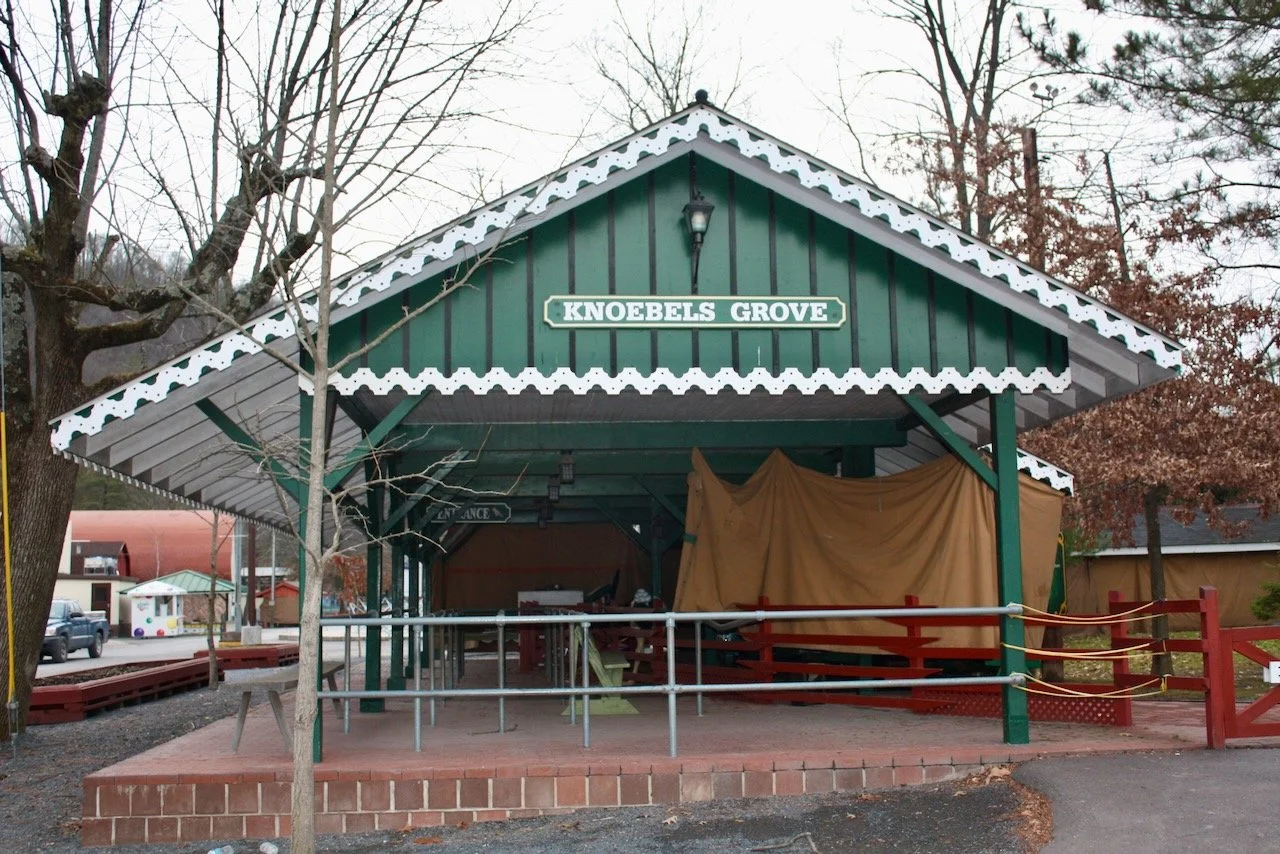
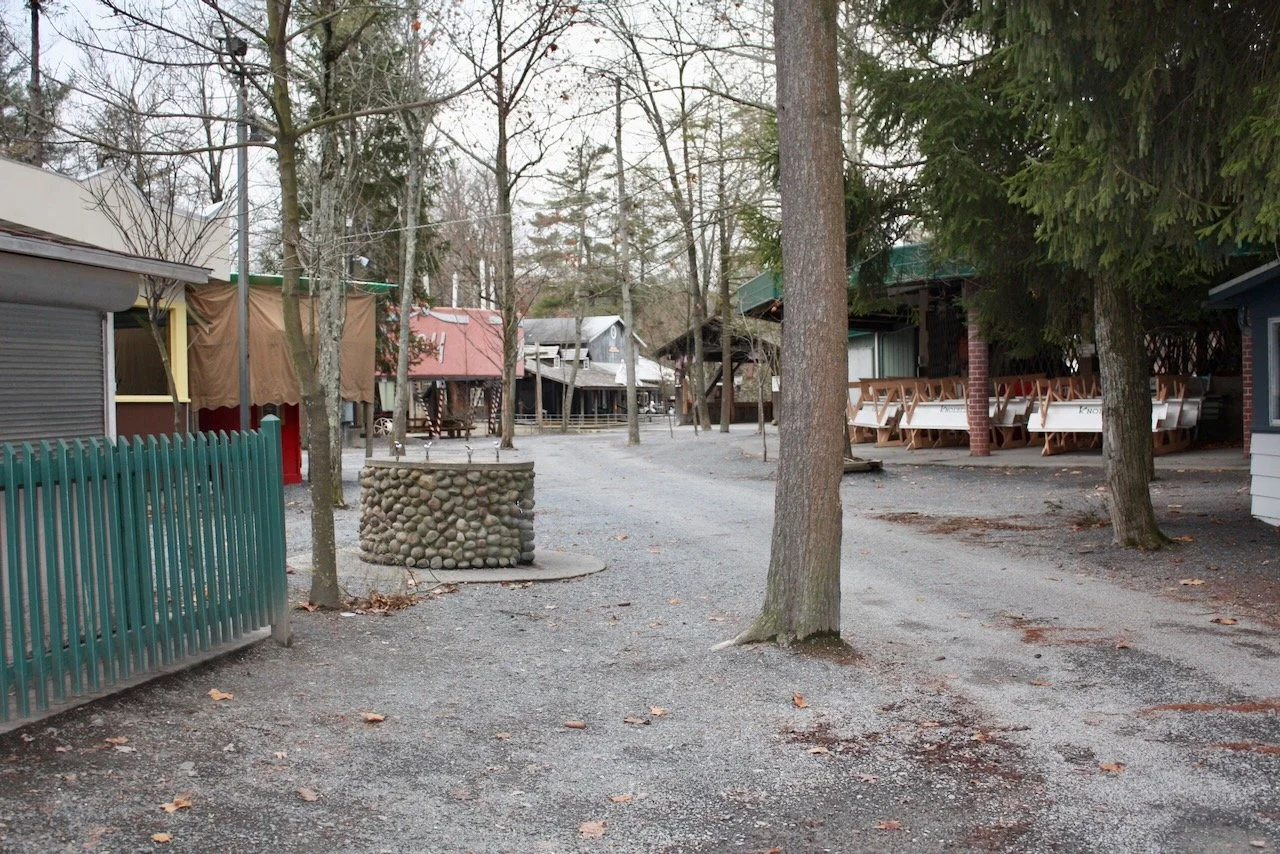
As we drove under the sign and further in, it became very clear that this was not a normal fenced-in amusement park, closed off to the public off-season. The park had no fence. The public roads run right through the park, and the various rides and structures were laid out all around us. We were driving past amusement park rides, right next to the car. We parked and started our adventure.  I felt like one of those explorers of abandoned places you see on YouTube.

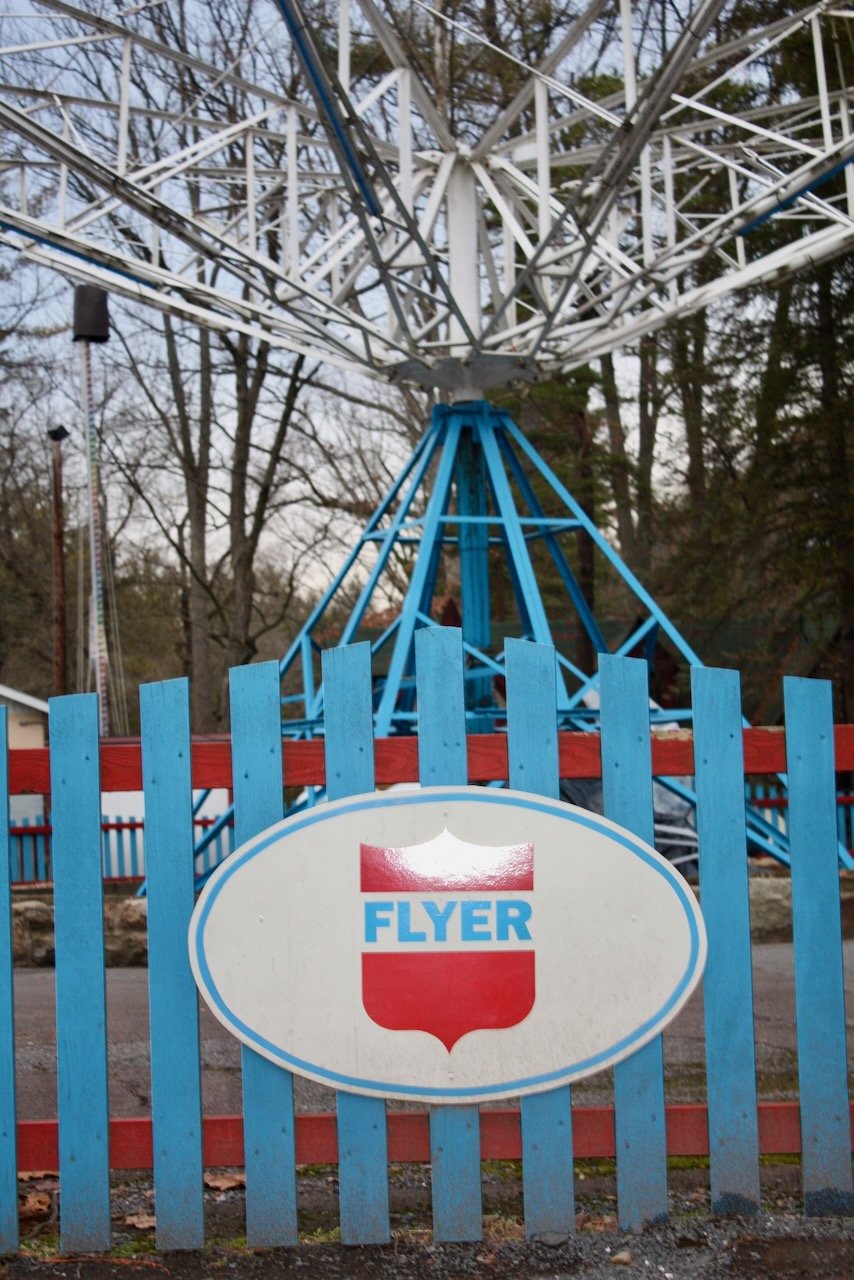
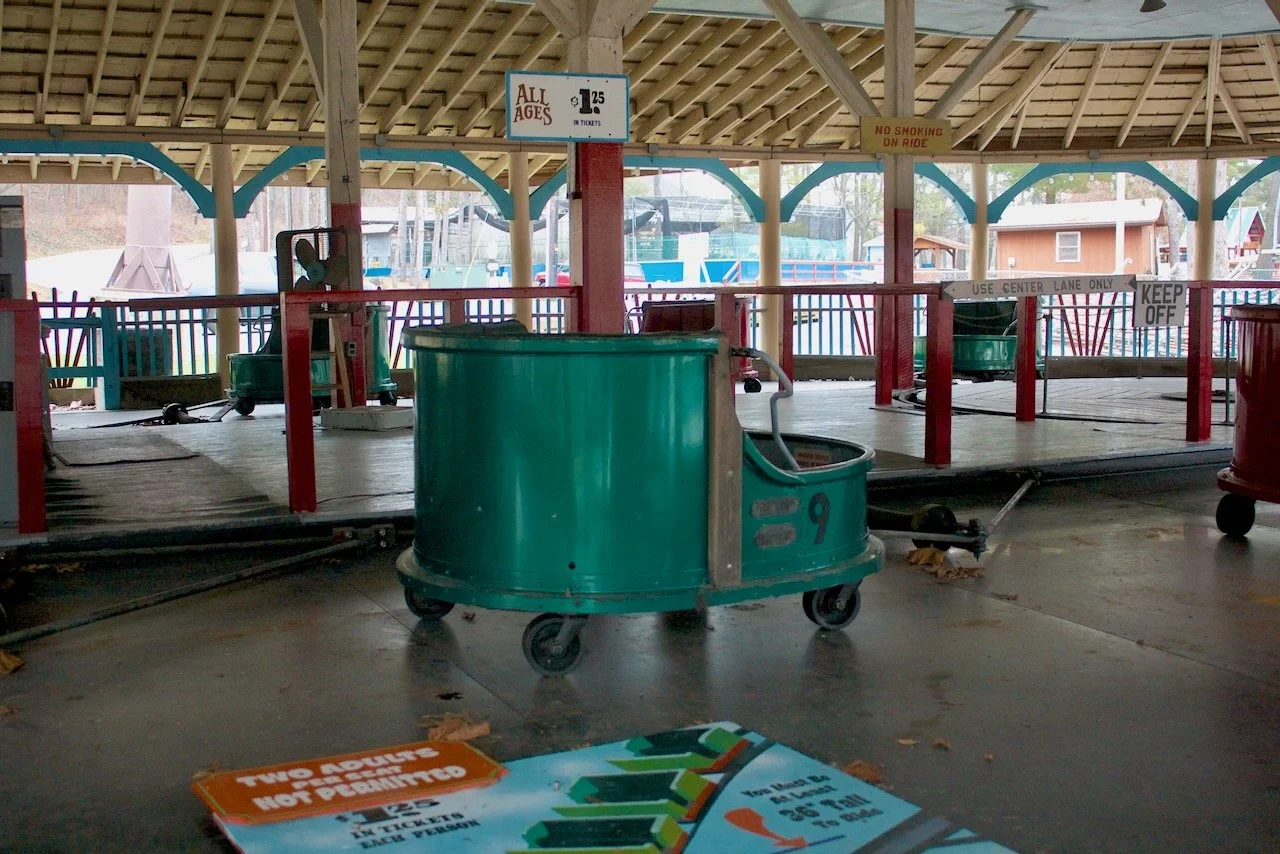
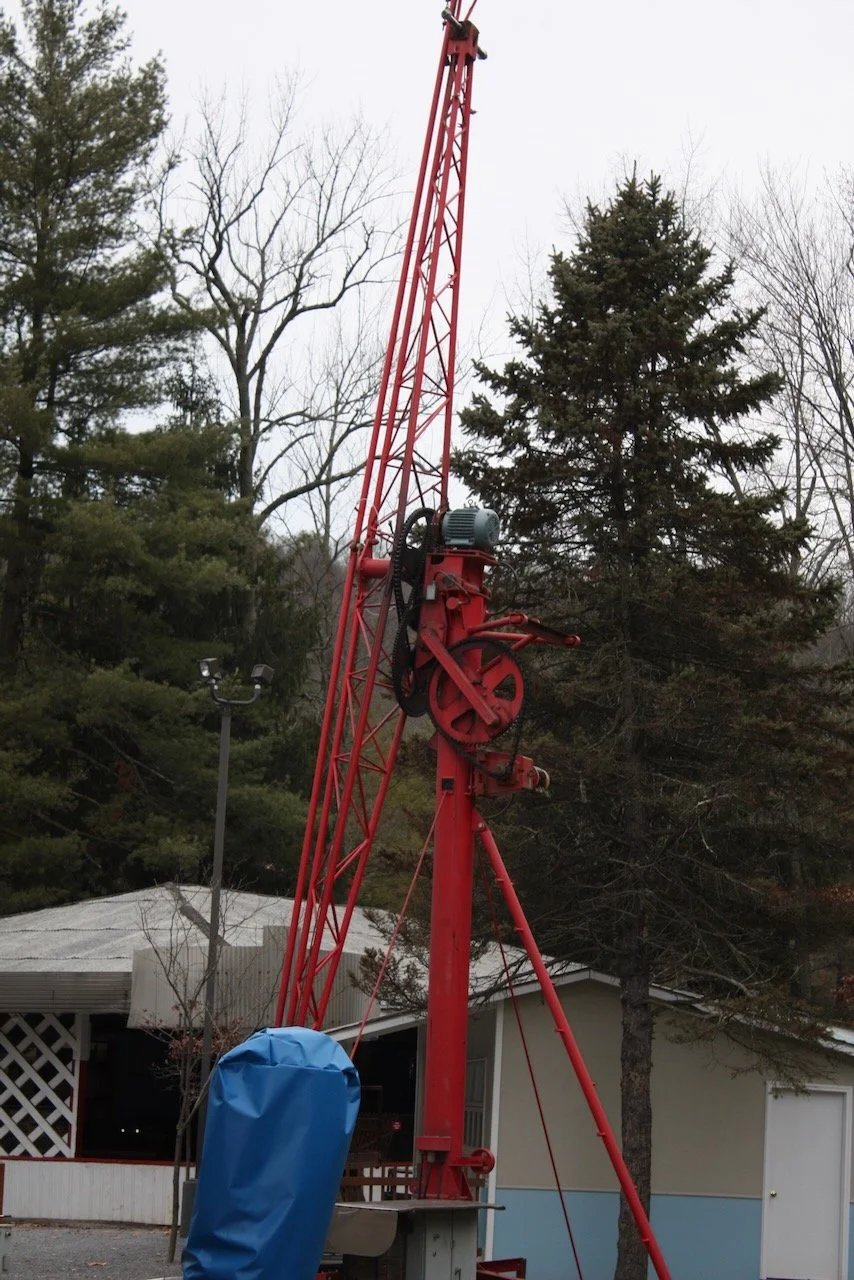
They had an old Whip ride, and we walked up the ramp to get a good look at the ride platform. There was a big fat raccoon walking around. Once he saw us, he scurried into where a floor panel had been removed, his winter den. We strolled around an abandoned park in our winter jackets, past various structures, food stands, game buildings, an arcade, and the flat rides, all in various states of disassembly for the winter. The paratrooper, the roundup, the roll-o-plane. All of these rides that had been at the various parks from my childhood appeared to be brand new, as if they had just come out of the factory. It was incredible.

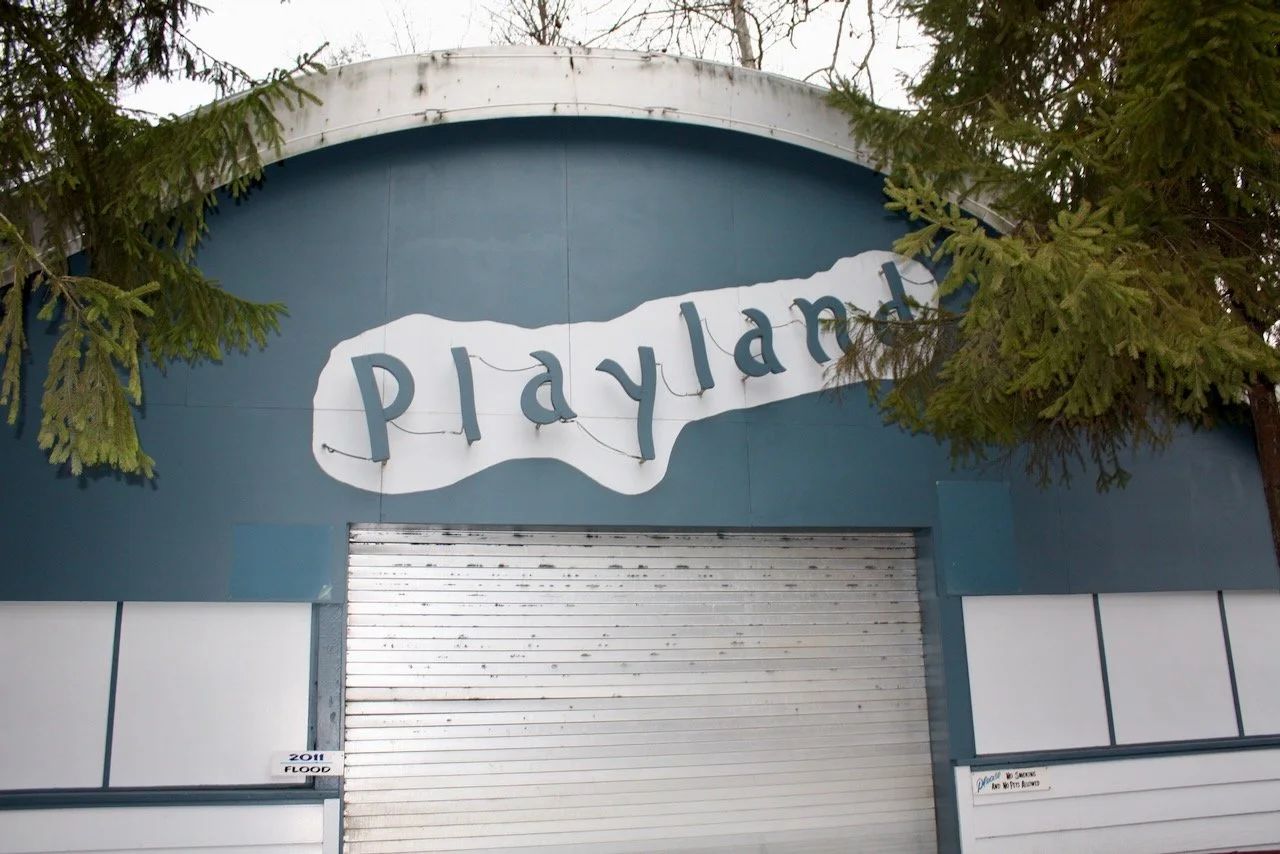
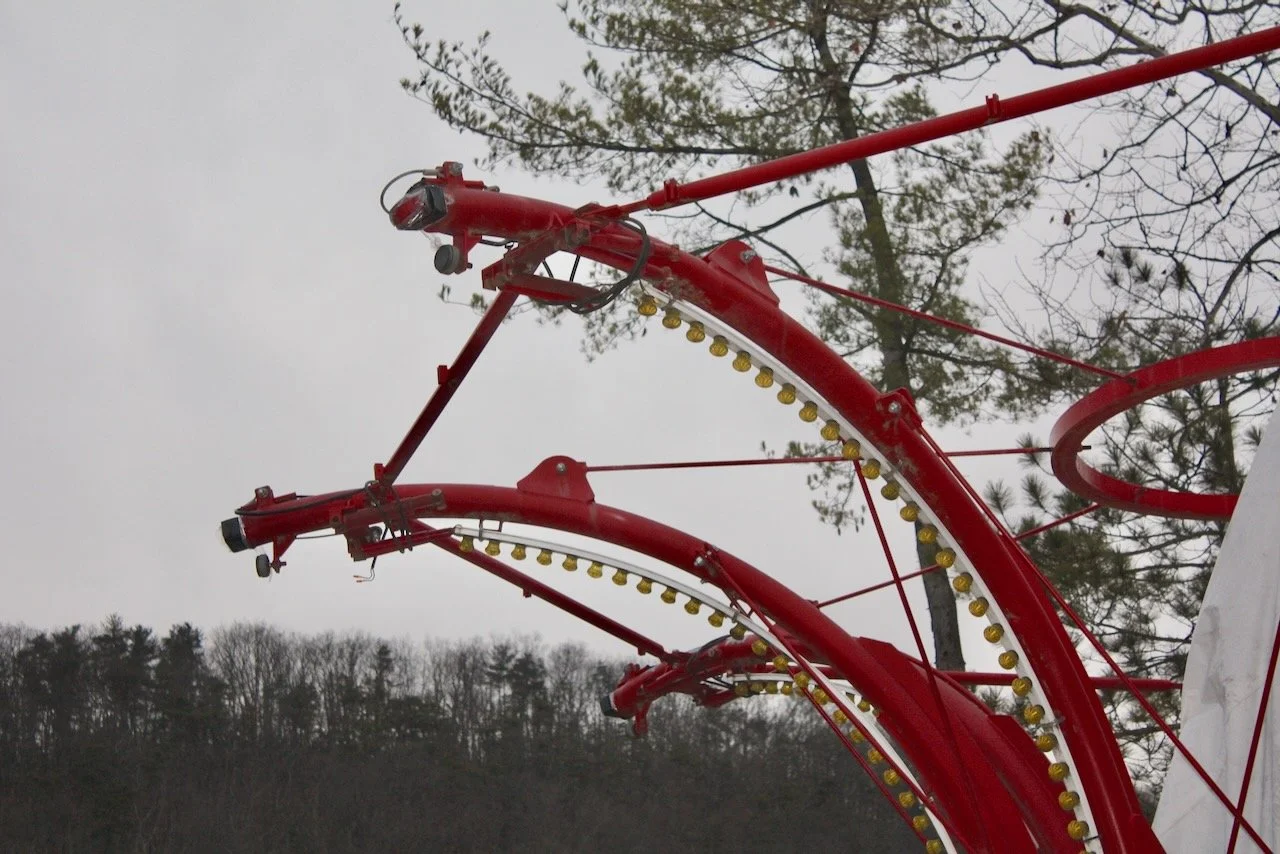
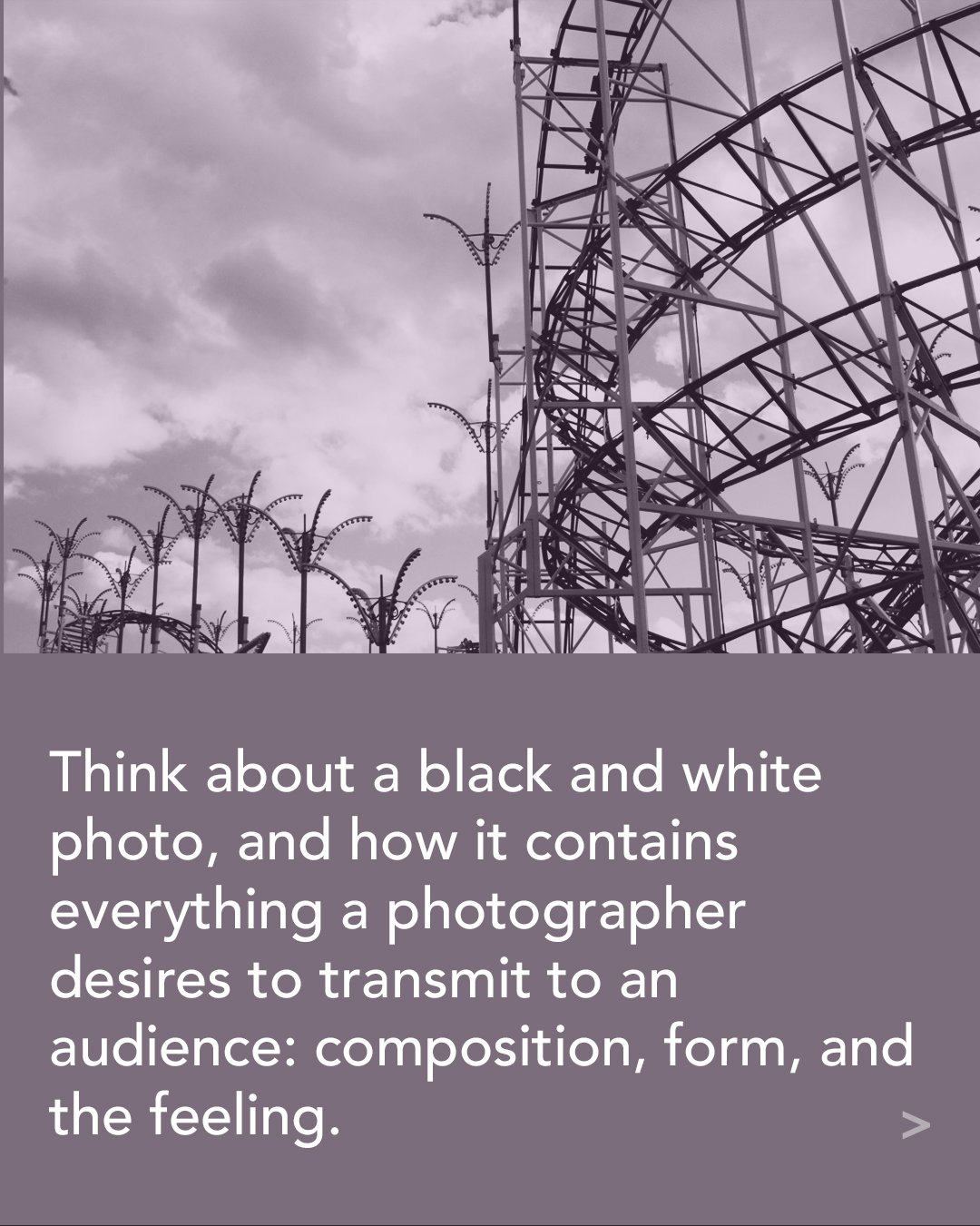
Throughout all this exploration, off in the distance, I could always see the biggest reason this unexpected visit was so exciting, the famous Phoenix Rollercoaster. The Phoenix is legendary in coaster circles. A wooden double out and back configuration originally built in 1947 as the Rocket at Playland amusement park in San Antonio, Texas. Playland closed in 1980, and it remained SBNO (Standing But No Operating) for a few years until Knoebels, which also owns a lumber business, purchased it. They disassembled the Rocket, transported the pieces from Texas to Elysburg, PA, and reassembled it as The Phoenix. It is always one of the top-rated wooden coasters in the world, so through all of this exploration so far, I knew the big payoff was still to come.

Eventually, we made our way back toward the Phoenix. It is a very long and narrow coaster that stretches across the back of the park. The entire ride was visible because there was a large open area along the entire side of the structure. As the Phoenix came into view, we noticed 2 pickup trucks and some workers on the structure. As we approached, one of the men started to approach us.

“Oh no, we are screwed,” I whispered to Ditty.

“Calm down, Dickles,” he reassured me, “it's not a big deal.”

The man approached. He was a large guy with a grey beard wearing well-worn clothes. “Are you guys with A.C.E?”

Instant relief -  A.C.E. was American Coaster Enthusiasts. Of course, I was a member of ACE.

“Yes! This is my first time seeing the phoenix.”

“Would you like a tour?”

This situation was turning into a complete miracle.

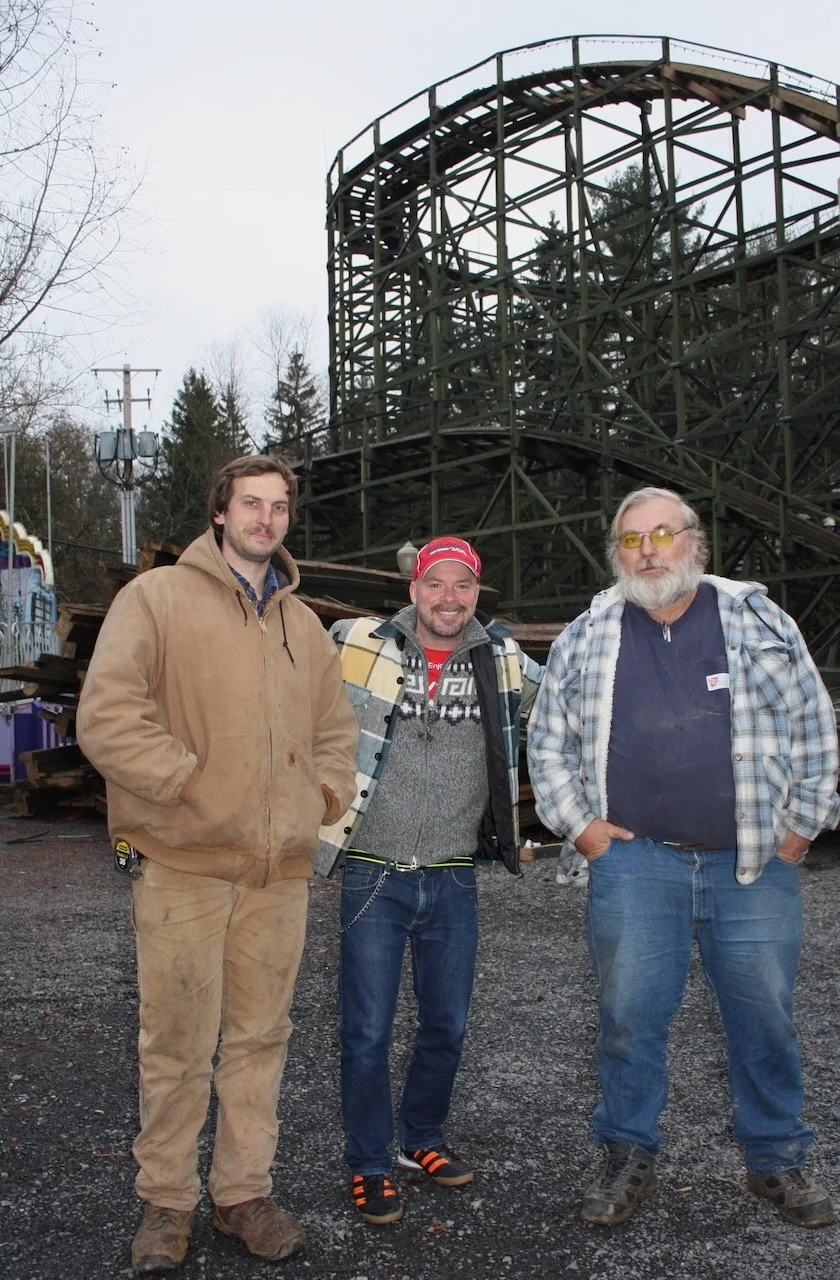
We introduced ourselves. Len worked as a roller coaster construction contractor and consultant. Imagine that, a roller coaster consultant! His company was currently doing some track modifications and upgrades to Phoenix over the winter. His son was with him. He told me how they had worked on many wooden roller coasters around the US at various levels of capacity. This was the first time I had even met someone who actually built roller coasters.

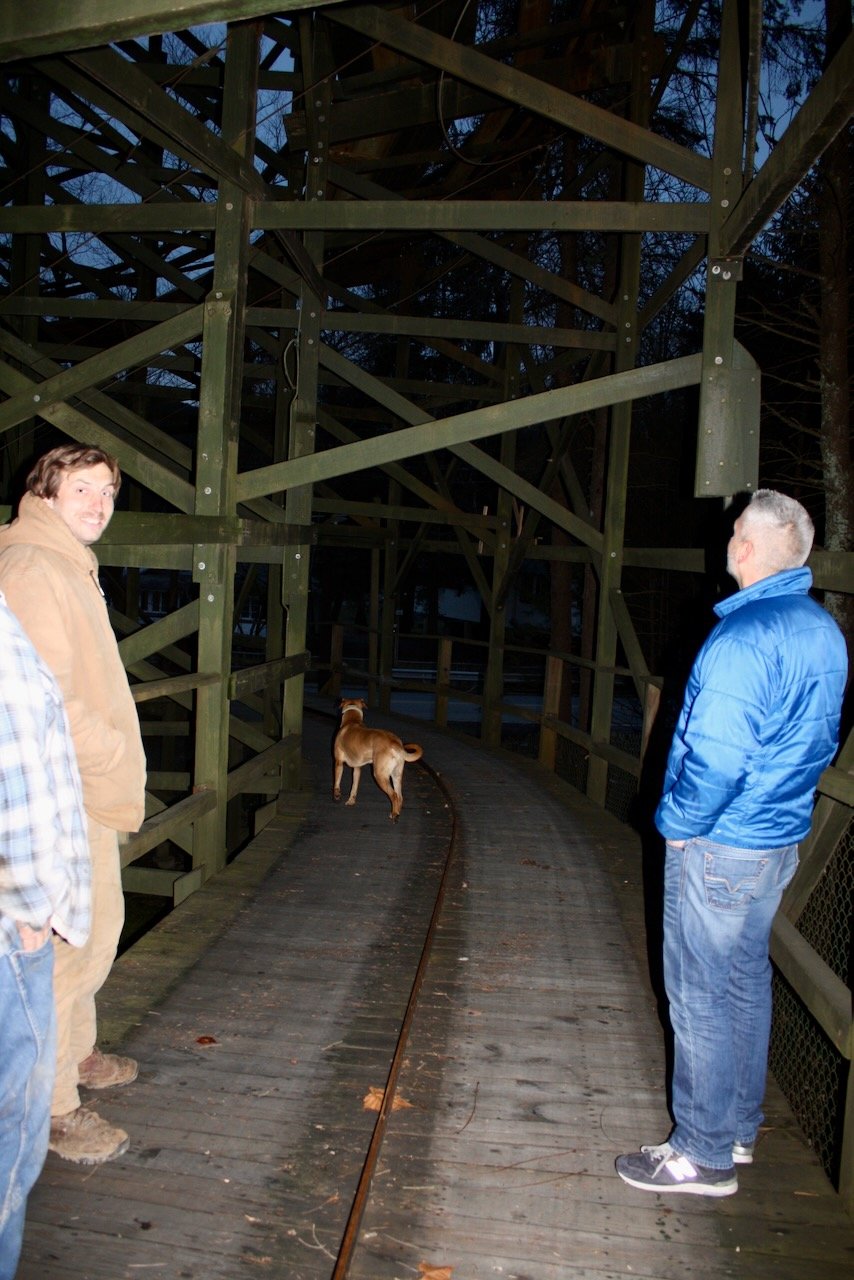
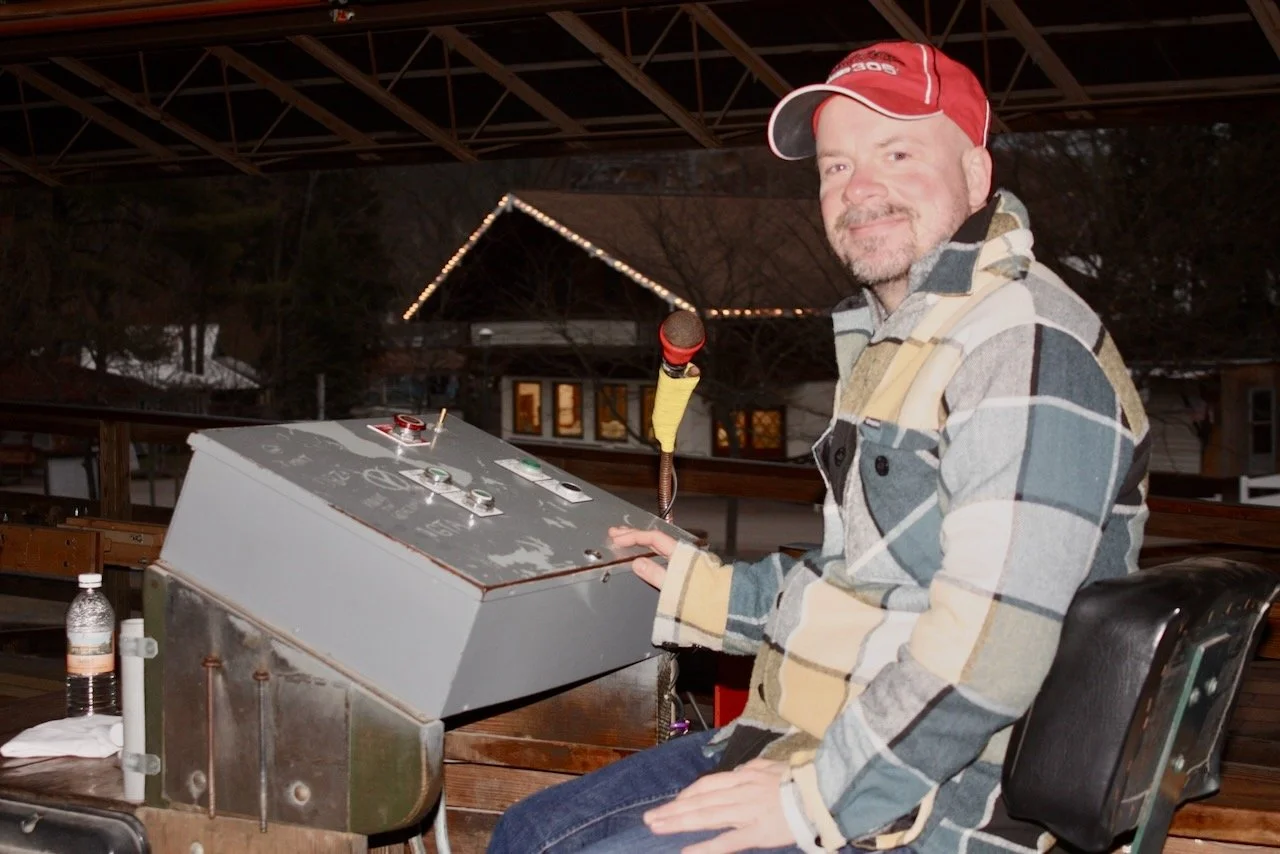
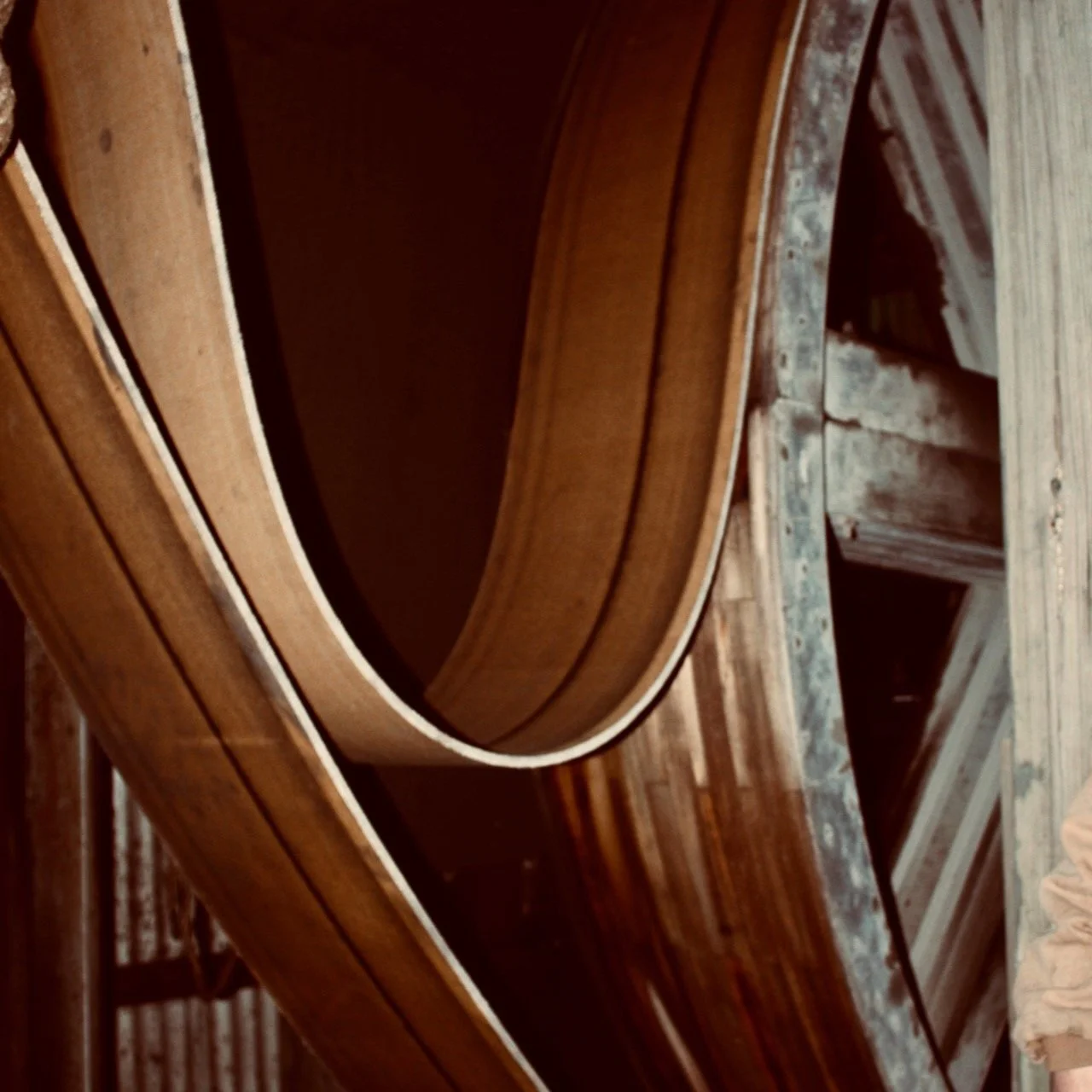
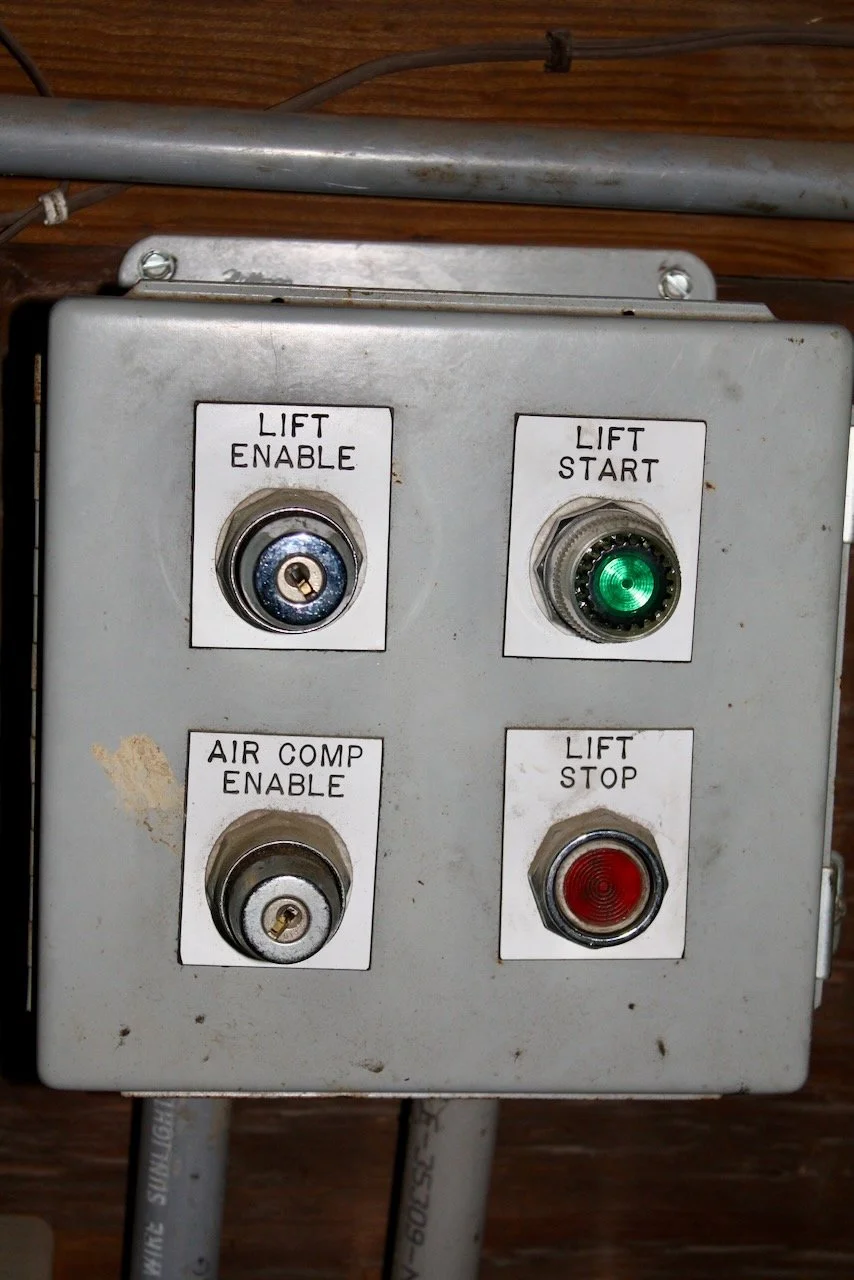
Len took us for a full tour around Phoenix. We went under the entire structure. We walked on the Tin Lizzie ‘Olde Fashioned Car’ track that runs under the coaster. We then went up to the station, which was covered in sawhorses, tools, and working equipment. I had been in many coaster stations of my lifetime, but never in this state. It was so cool to get a behind-the-scenes experience.  I got to sit in the Phoenix’s control booth. Len showed me what all of the buttons on the control panel did (there were fewer than I expected). We got to see the giant flywheel and mechanism of the chain lift - I think it was called the “lift shed”. There was also a curvy, dark tunnel that the car entered after exiting the station, before it hit the lift hill.  We walked through the dark tunnel together, then were brought out into and under the coaster structure.

Len spent an hour with us on that cold December day and took photos with us. It was generous of him. He was truly a coaster lover like me.

Ditty has always been a generous, thoughtful friend. The Knoebels Christmas miracle remains one of the most special gifts he’s given me.

The Power of Copying Excellence

When I started engaging with art education, instructors often assigned copying famous works of art as a valuable exercise. At first, I questioned its value, believing that creating art was primarily about self-expression and personal development. Copying seemed unrelated to these goals, making its purpose unclear to me.

My first time copying another artist's piece was only a few years ago, and the experience was surprising.

The initial thinking that copying another artist's work could be of creative and developmental value showed up while learning piano. I started formal piano lessons about 4 years ago. While I had tried to teach myself on a somewhat successful path, I realized formal teaching with hands-on guidance and structure would enable me to make very large jumps in development and ensure I was learning properly.

Once my piano-playing skills were established at a foundational level, I was given primarily classical music pieces to learn. Essentially, I was copying another artist's creative output. Unlike with visual art, I never questioned this as the proper next step or as of value to me as a student. The idea of learning another composer’s piano music seemed the logical next step in piano, and I never considered it copying.

As I worked through these original, unarranged pieces, I had to deconstruct them into smaller segments I could learn from. I repeated these sections until I understood them, and they became part of my muscle memory as a pianist.

I continued this process with each segment, gradually advancing through the piece.

Eventually, I connected the practiced segments, experiencing the composition as a whole.

Doing this created a unique connection with the composer by allowing me to better understand their intentions and the journey they wanted to guide the listener through. It felt as if I got to know the composer personally, which was a completely new experience for me.

My first time really copying a painting was only a few years ago. I had hit a point of stagnation as a painter. I usually have a pool of ideas and inspiration for paintings and topics that exceed my output and  time capabilities. I am never short of subjects to explore. However, sometimes I do hit dead spots. I guess these would be what's called writer's block for an author. I get to the point where nothing seems worth initiating or committing to.

I dislike creating in this space because my work rarely feels high-quality or interesting, and this sometimes feels damaging to me as an artist. With paint, I create a permanent artifact that sits in my studio or sketchbook, leaving an impact. By contrast, a bad piano day means my creativity simply dissipates into the ether, never to be heard again.

I decided to focus my creativity and use paint actively—I decided to copy.

I turned to The Museum of Modern Art, New York, a book I love to start my day with, preferring art books over scrolling the news.

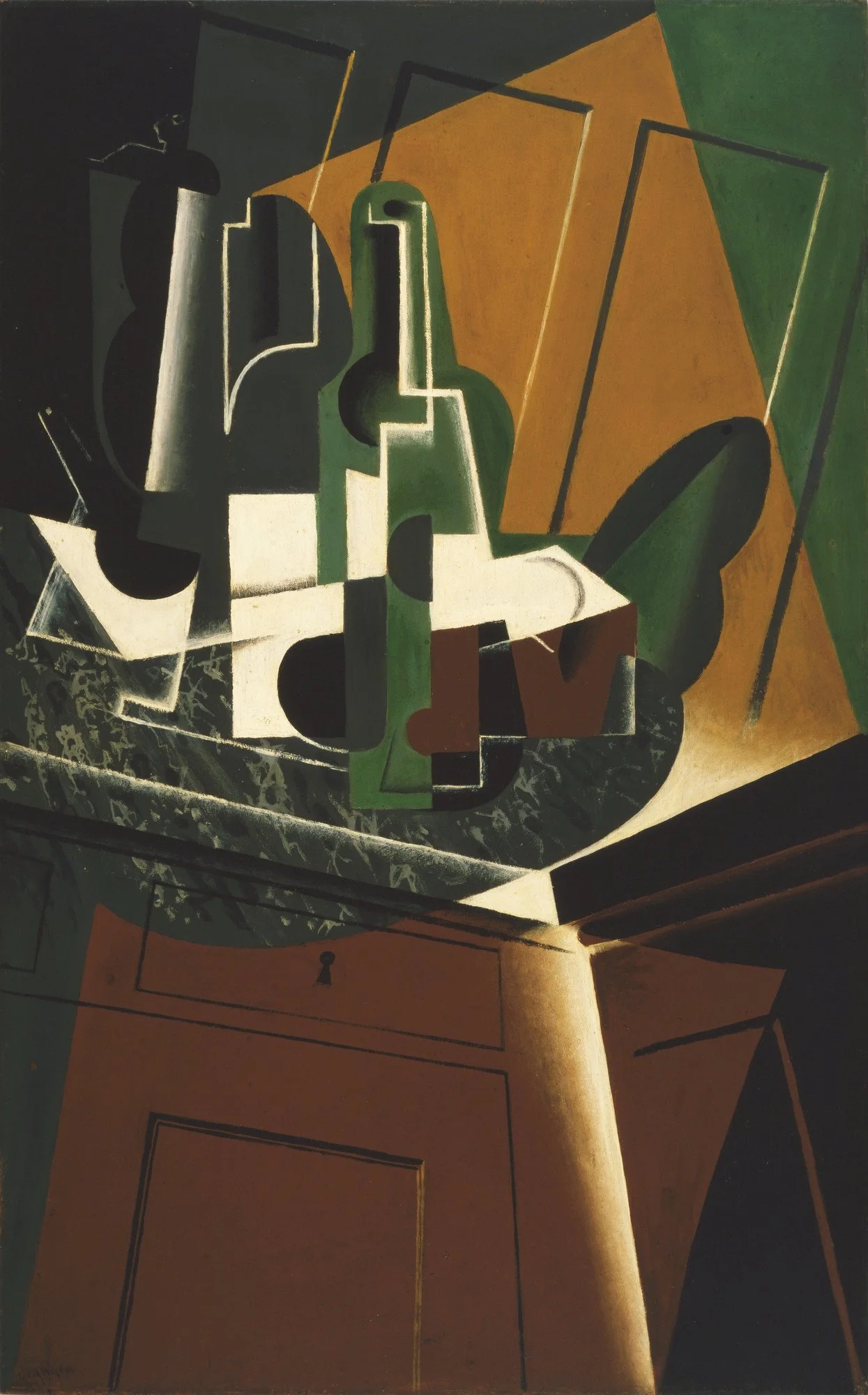
Juan Gris. The Sideboard. 1917 .

oil on canvas. 32 3/4 x 51”

I found something of interest: The Sideboard by Juan Gris from 1917.

The painting’s unfamiliar style intrigued me. Its dark, desaturated palette appealed to me, and the subject—bottles on a table—was clarified by the title. Still, I didn’t initially understand Gris’s approach.

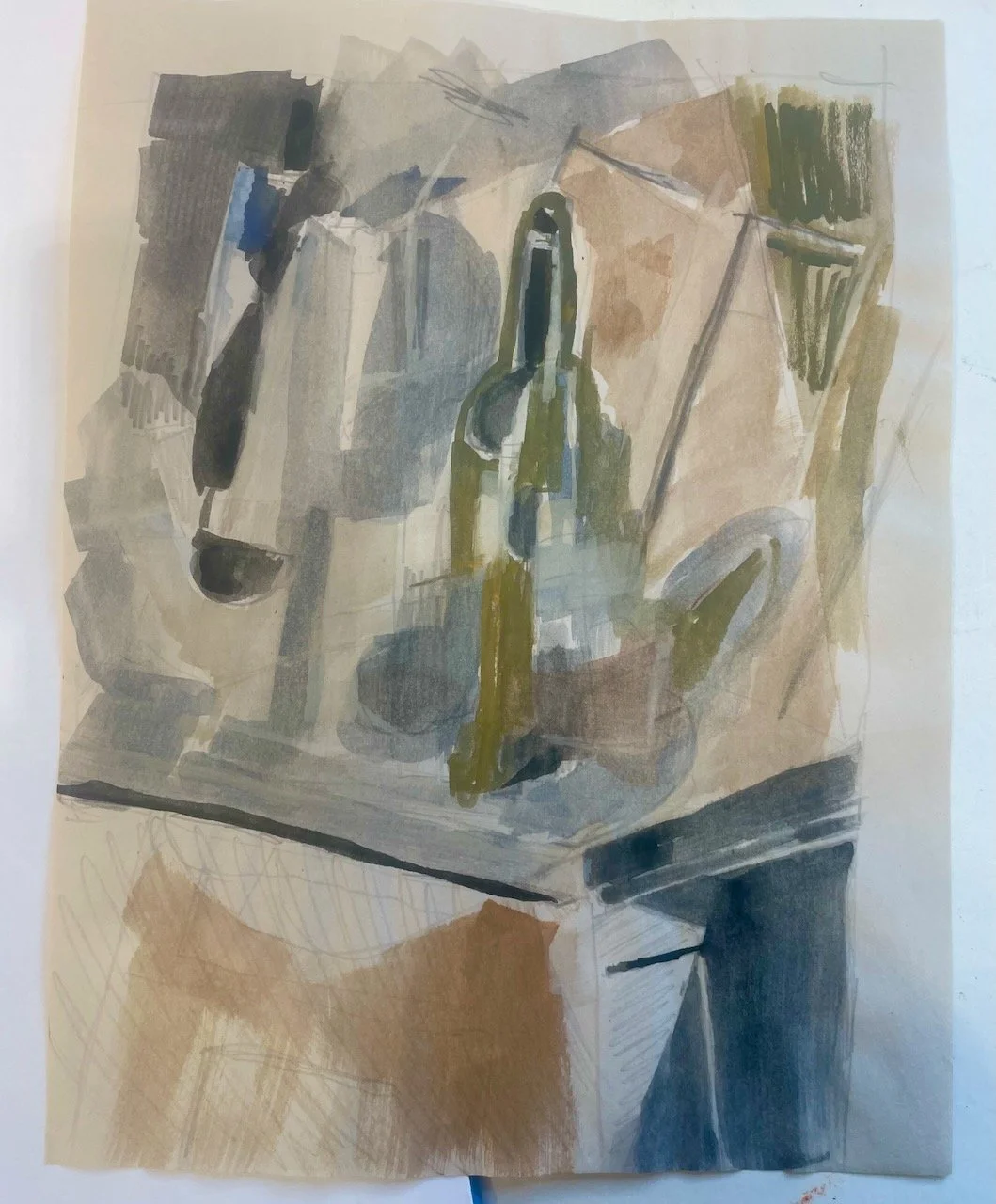
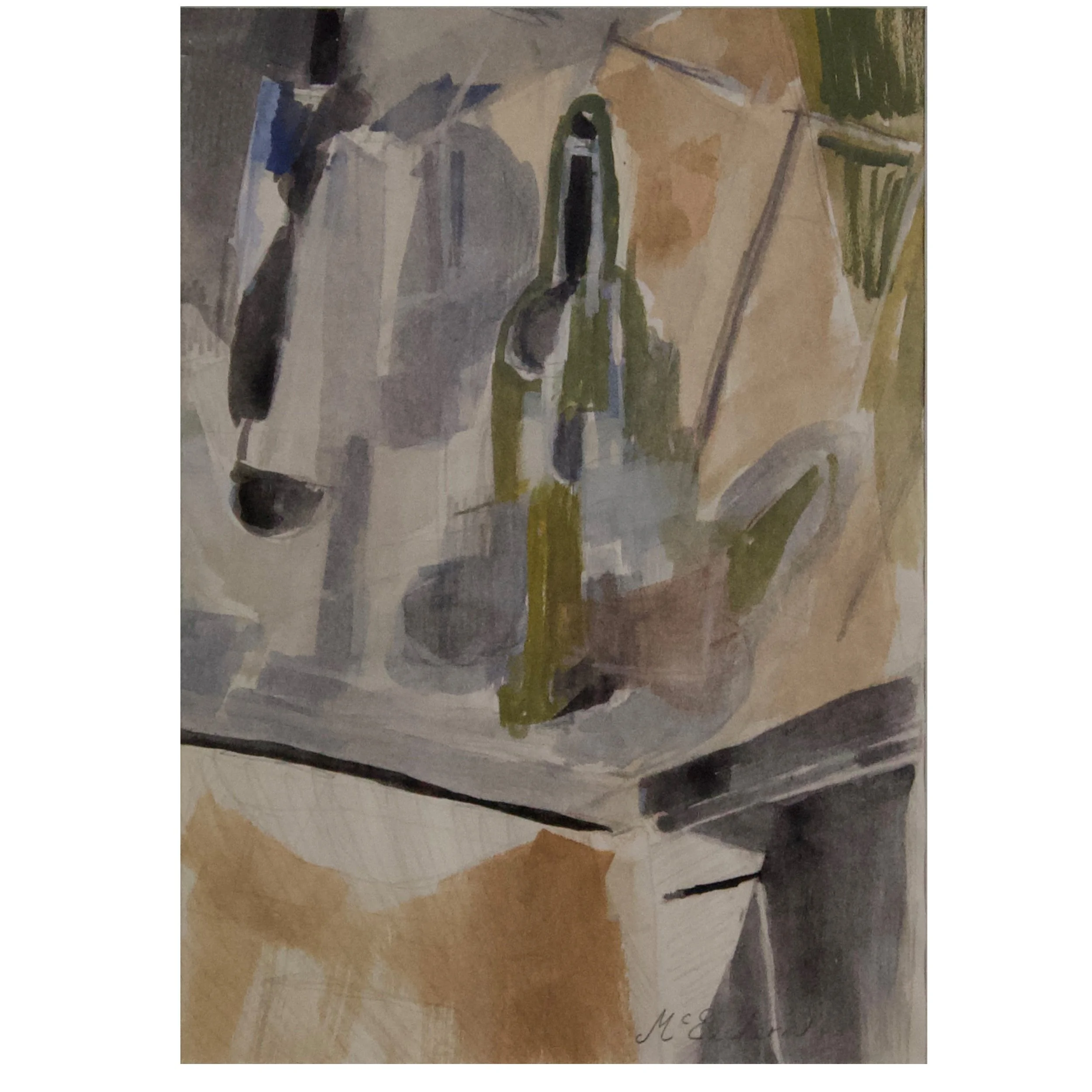
This all changed when I started doing my own version in gouache. The artist’s brilliance was revealed. It was a fascinating experience. The fullness Juan Gris used, the interesting way of conveying shadow, shapes, and lines, was revealed. The use of color was very clever and thoughtful. I was completely immersed in this painting. It was as if I were on a mini adventure with Juan Gris. I was connecting with him in the same way I would connect to the composer in piano.

Untitled

8x10’ gouache on paper

matted and framed

I realized that copying not only visual art but also literature and poetry can shape our perspectives. This approach offers an interesting way to explore how our brains develop through imitation.

How could you use these exploration and learning techniques to enhance your learning and discovery?

The Purest Art in the Room

Whenever I visit a museum with friends, I always ask everyone,” What was your favorite artwork?. It is a way to get to know people and hear what art is meaningful to them. In many ways, art can reflect an individual.

The 8th-grade Art class at Marshal Simonds Middle School in Burlington, Massachusetts, was run by Miss McCarthy. She was no-nonsense and forthright, and wasn't shy about sending a misbehaving student to the ”office”. A terrifying directive  I personally never experienced but witnessed quite regularly.

Even back then, I sensed Miss McCarthy’s stern demeanor was intentional—a role she took on to maintain control and order among us. Beneath her strictness, there was the feeling that she cared about creating a good learning environment.

8th graders cover a wide range of personalities and maturity levels, which can create a dynamic challenge for both students and teachers.

The art room was huge, with large windows along one wall flooding the space with natural light. I recall the other three walls were covered floor to ceiling with a variety of art supplies in various shapes and sizes, creating a colorful, textured enclosure that surrounded the students.

The kids sat behind a large U formed by huge, high, wide, and deep wooden tables.  These had a Matte black surface and were covered with dried paint. Miss McCarrthy sat at a regular teacher's desk at the front of the room, so it was lower than all of ours.

It was the perfect room to make art.

I don't remember many of the projects we did, as I was more interested in science than art then. Inspired by M*A*S*H, I wanted to be a doctor and focused on math and science.

Miss McCarthy established fixed, assigned seating for the whole year, and the student next to me was named Roger. I was aware of him because we had been at the same school for a few years, but I don't recall ever having interacted with him.  Roger was a quiet but very cool kid.  I was not.  

I realized right away that this was a risky situation: we would be spending 1 hour a week next to each other making art, painting, and drawing, and I knew I had to try to keep my wits about me and keep the stupid things I said to a minimum. This was not like algebra class, where you had to pay attention to the teacher or do complicated word problems that required 100% focus - this would be art-making, which would allow freedom from thinking and talking, and storytelling.

The reality was that I was a weird kid. I looked and dressed completely normal; in fact, I was often told I was cute. But the way I look at the world can be strange, and I had a habit of talking a lot to try to be funny. In making new connections, this usually started well with kids thinking I may be charming or humorous, and eventually morphed into me just being annoying. My goal was to delay this inevitable transition with Roger as long as possible.

The strategy was to keep my mouth shut and focus on my art. A solid approach I still adhere to.

One of the assignments we had was to create a still life drawing in class. We had to bring in something from home or something we had in school, set it up in front of us on the large, deep work table, and draw it with a pencil.

I took this assignment seriously and searched my home the night before for the proper object. I needed something visually interesting that also posed a technical challenge for drawing. I decided on one of my microscopes. I had two: a small, but heavy metal one that was more of a high-quality instrument, and a large plastic one that came with my TRI-LAB-PAK, a science kit from Gabriel that included tools for three fields of study: geology, microscopy, and chemistry. I would regularly collect water from the brook next to my house and look at all of the microorganisms - Paramecium, Euglena, and Volvox. Fascinating!

As I write this, the thought that I might have even the slightest possibility of having shared with Roger the wonder of unicellular organisms fills me with such complete panic.

Anyhow, I showed up at Miss. McCarthy’s art class and set my microscope on the table.

As I focused on setting up my still life, I looked around and saw what the other kids had for drawing subjects. There were some stacked books, an array of cassette tapes, and one girl had a cute stuffed teddy bear that was obviously very meaningful from when she was a small girl. I was feeling confident because my choice of a microscope was a mature selection, with a weight and physicality that felt very solid and adult. I guess I started to feel I was a bit cool.

Then I looked over at Roger’s setup, and he was doing the final adjustments, getting ready to draw. He had set up a pack of Marlboro Reds, lying on its side with the flip top open and a bunch of cigarettes spilling out.  I couldn't believe it. He had also set up a 3-ring binder to block Miss McCarthy's view. What a fucking badass.

In 8th grade, smoking was a thing for only a select few.  I considered it definitely a more social deviant activity than smoking pot. Pot was definitely a thing for many kids, but while I hadn't tried it yet, I knew it was done for a purpose: to get high, to make you feel good, to change the way you felt like getting drunk on alcohol.  

Smoking cigarettes had no other purpose than to tell the world you didn't care about the rules or authority. We were constantly drilled about the dangers of tobacco by our health teacher (who smoked!), so there was also that. And let's face it, Marlboro Reds were the ultimate smoking statement.

This was a risk at every level.  I glance over, completely shocked and in fear for Roger. Everything about this demonstrated uncertainty and exposure. What, if Miss McCarthy came over? Had he considered how to handle this potential situation? Would he casually drop the binder over the still life? - Wouldn't she see this was happening? If she saw someone tinkering with a “still” life as she approached, she would definitely know something was up and request to look under the bider. Had he not thought through the ramifications and scenarios?

What was his strategy?  My mind raced - how would he possibly focus on his drawing? You need to stay focused on the drawing process; you can't worry about proportionality and line quality if you are worried about detection.

He radiated a kind of peace I couldn't understand. He was steady, unfazed, almost serene in the middle of my mental chaos—a quiet confidence I envied intensely.

We started the drawing process, I with the dull grey metal microscope and Roger with the colorful Marboro reds. I definitely remember Roger's complete sense of calm and confidence that day, a slight grin as he sketched. He had a kind of peace I couldn't understand. He was steady, unfazed, almost serene in the middle of my mental chaos.

I don't recall speaking to him at all during that drawing session. I knew we were different, but that really drove it home for me. I had looked down on kids who smoked as those who made bad decisions. I definitely felt a sense of slight superiority that I was making good decisions, while they were not. After that class, it changed. I realized there was something of value that Roger had that I did not. 100%

Looking back, I realize this was such a great artistic moment.

Art can be creating something that expresses what you desire, or a unique way of seeing the world. Interesting art often reflects a part of the creator, how they see themselves in the world, and their point of view. It can often be a place where someone can be true about their fears, their frustrations, the discrepancies between how they see themselves and how the world sees them.

One of the questions I often ask people is, “If you had a time machine, where would you go to any place or time?” I have a series of standard answers: the Castro in 1970s San Francisco and Hollywood in the late 1920s, when sound was coming to movies. But I think I have a new answer to that question.  I would go back to that drawing session in Miss McCarthy's art class that day and tell Roger:

“I think you are a fearless, creative badass, and this is the purest art in the room.”

I’m sure he would think I was fucking annoying.


Yoga for the Oil Painter


My experience in Florence, Italy, transformed my appreciation of the challenges and importance of drawing the human figure, inspiring my personal growth and resilience.  I was there for 7 weeks as part of the Florence Academy of Arts Drawing and Painting Intensive. The class was a condensed version of the 2-year course of study, covering the same topics but drastically shortened. Figure drawing was a component of the curriculum, and one that was both challenging and transformative.

Figure drawing of a long 3+ hour pose is a different set of challenges that doing a series of short, say 15 min poses

The class ran for six weeks, from 9 to 4 pm Monday through Thursday. Friday was a free day, and we were encouraged to explore the city's many museums. There were 12 adult students from around the world with varied backgrounds.  The whole program was intense and very guided. This was not like the classes or workshops I had experienced in Boston/Cambridge, where students could pick their subject or start creating art, and the instructor would walk by to offer additional feedback and a little guidance.

Replicating classic anatomical drawings was a great way to start this intensiove class.

This was more like what I envision the military to be. We were provided specific subjects to paint. We were told how to place the subject relative to our drawing or painting surface. We put masking tape on the floor to mark the easel and subject so that if we needed to come back the next day, we would be sure everything was in the same place.

We used masking tape to mark on the floor where our subject and easel were to ensure everthing was always the same positioning.

We were instructed on how to look at an object, what to look for in a subject, how to measure an object's dimensions, and how to estimate its proportions. We were guided on how to start a painting and given a heads-up on things to avoid. It was incredible, and I enjoyed it immensely. However, it was truly like drinking out of a fire hose. There was so much new information and skills in such a short time, and I learned that trial and error is a vital part of mastering art. Embracing mistakes and persistence helped me improve.

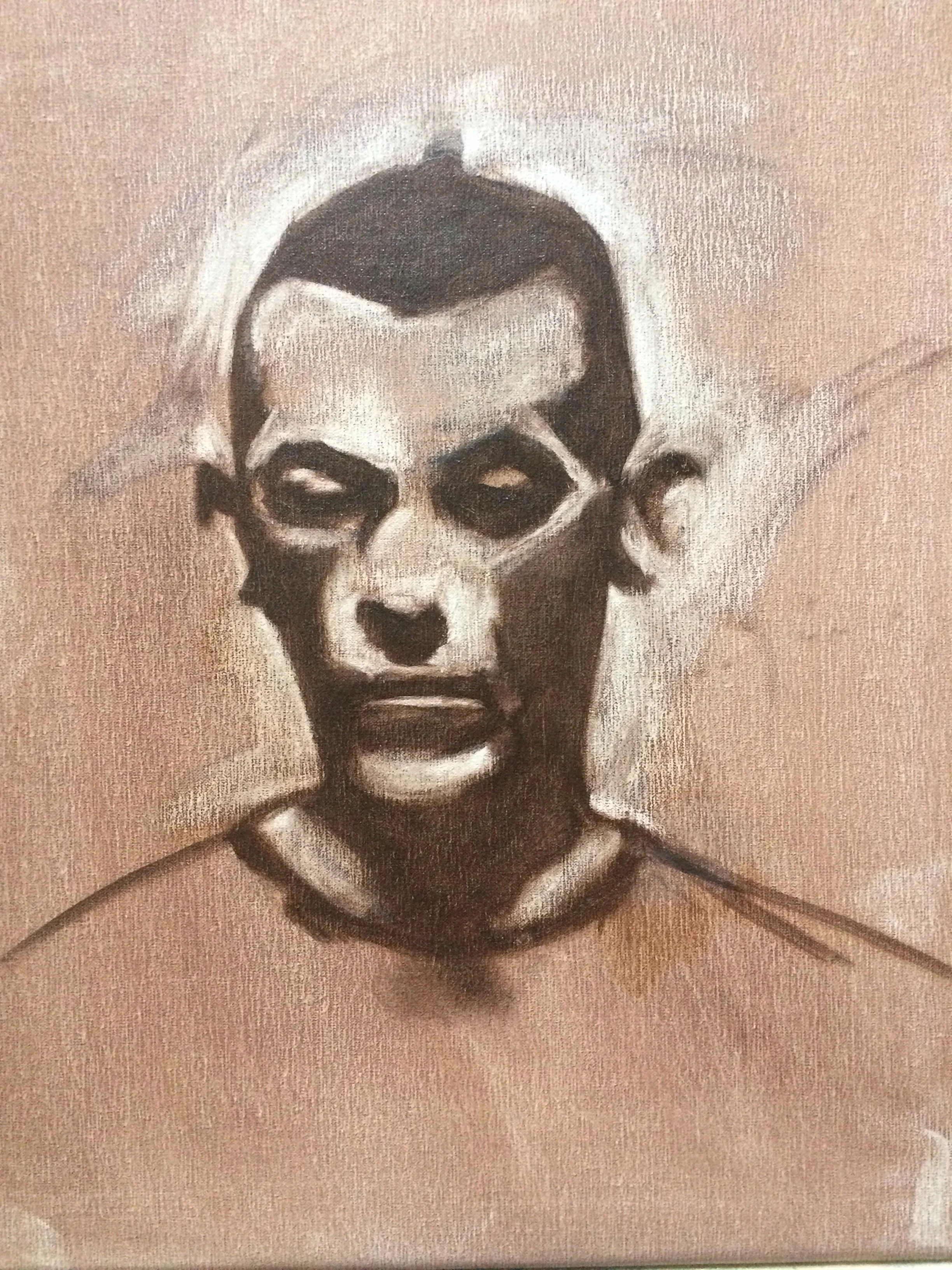
We started the course by copying classic drawings of anatomical elements, such as an arm or a hand. The expectation was to replicate the drawing exactly, including the line weight and form. Initially, it was not a very creative experience but rather like a series of technical drills. I recall having drinks with all the fellow students after class one evening, and we shared how the class experience was different from what we all expected. Everyone was very appreciative of the instruction and the learning experience. Still, we joked that our friends at home would be expecting to see lots of elaborate, colorful paintings we would have created after 2 weeks in Italy, when all we had made were a few high-quality drawings of hands and arms. It was very humorous. It really bonded us as a group, as we were experiencing something very special and unique to us, something no one but us would have understood.

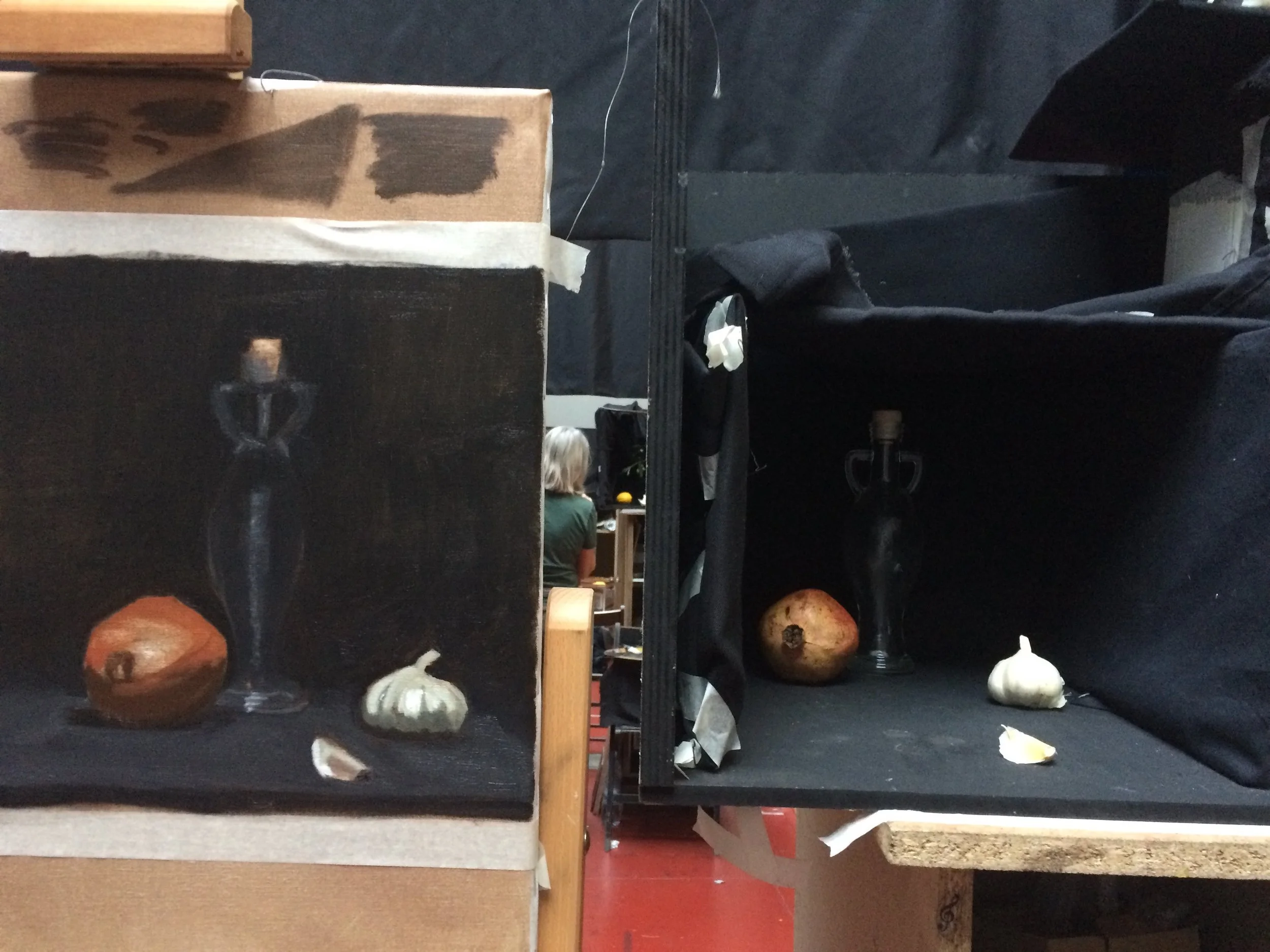
After more elaborate drawing experiences, each lasting at least 1/2 a day on a single subject, we moved on to painting. Painting was started very simply, four colors with the simplest still life, a single pear placed in a black box to create the background to make the object really pop. 

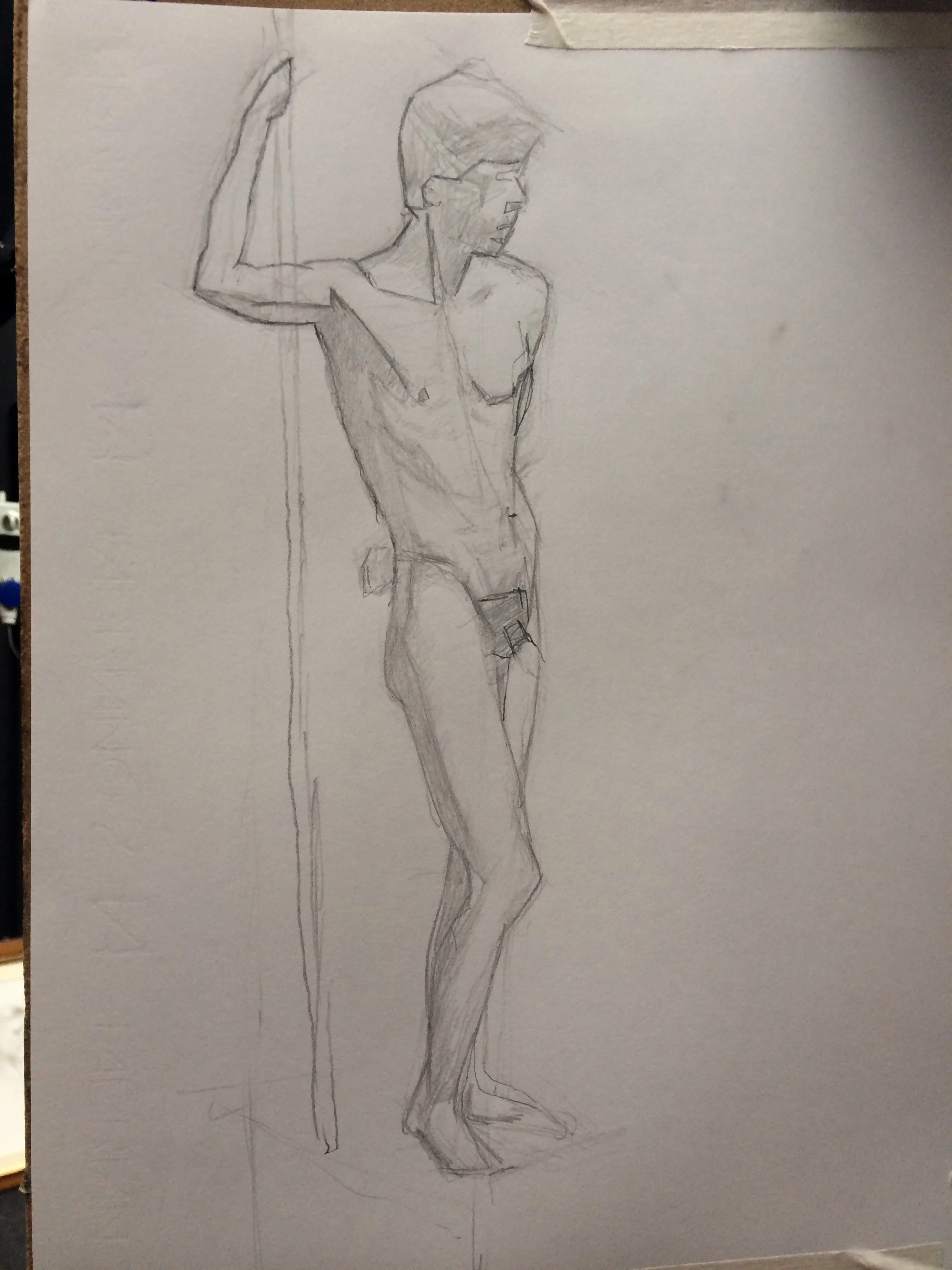
The pinnacle of the class was figure drawing,  closer to the end, as it really relied on the skills developed in the previous weeks. I actually had two different experiences with figure drawing in Italy. One was in a very guided class. The other was more open and free, at a drop-in figure drawing session open to the public on Thursday evenings at our school.  This was quite interesting as I was able to be exposed to other artists beyond those in my class, some of whom were highly experienced. In these open studios, there was no guidance offered, as there was no instructor. There was a minimal fee, and attendees would bring their own drawing or painting tools. As I recall, almost all of the students were drawing.

Even a non-artist can tell if the alignment of the human form is off even in the slightest

The model had a handler, someone who would deal with the individual leading the session, handle the business side of things, and certainly book the gig. I found it fascinating that being a life model could be a real job in Florence, Italy. The model would work with the open studio lead to set up the pose. The model would be on a slightly raised platform in the front of the studio, with the students arrayed all around their canvases at about a 120-degree angle.

 They would hold a single pose for the entire session, about 3 hours, so the pose needed to be engaging and developmentally valuable to all students, regardless of their location around the platform. There was a lot of back and forth, with the model making changes - hand on thigh? Hand on hip? Seated or standing? Leaning on a vertical rod? With the light adjusted to show good shadows, revealing the form. 

Once the pose was established, the session would begin. As a beginner figure drawer, 3 to 4 hours in a single pose is a very different experience and expectation from the typical short sessions I was accustomed to.  In my previous experience in Boston and Cambridge, MA, any time I participated in figure drawing sessions, they were a series of short poses, each maybe 15 minutes long, and then the model would change, and a new drawing would start. These became more of a quick sketch, attempting to capture the proportions of the figure, a challenging task in itself, and documenting the most significant differences in value. The shape of the darkest shadows, the contour of the medium values. The expectation of detail and fidelity can be low, since you only have this short period of time for the pose before moving on to a fresh pose, fresh paper, and a fresh drawing.

With a long-form pose, expectations are higher, and the approach is very different. Luckily, the Academy provided us with specific techniques in the figure drawing segment of the curriculum. They offered techniques and methods for each phase of the drawing process. Locking the key points of the figure on the surface,  the top of the head, the lowest point of the figure, usually the end of a big toe pointed down, the chin, breasts, pubic area, and knees. These would all be marked on the paper first vertically and then horizontally. It is the most essential part of the drawing, and having professional guidance was helpful. However, even with the guidance, this is highly challenging.

There are aspects of figure drawing that make it so unique, powerful, and foundational to a visual artist. You do not need to be a trained art instructor to know if your drawing is not reflecting the subject accurately. As a human, it will be very apparent. This is very different from documenting a subject, such as a landscape, where it can be more forgiving. Suppose the relative distance between a tree and a barn is a bit off. In that case, it will not jump out in the same manner as if the distance between the shadow of an eye socket and a nostril is off, even in the smallest amount. You will know immediately. 

This introduces a series of alerts, but knowing how to fix them is another story. Shifting one element will affect everything else. And there is also the technique of erasing and redrawing. It is a constant flowing, lively experience that is one of the most challenging mental experiences I have ever encountered. Because of the fact that you can see, process, and be aware of any errors, and that everything is completely interrelated, and you are dealing with the most fundamental parts of our brain, the human figure. We are hard-wired to process the human form.

Developing the skill to draw the human figure is one of the most profound examples of the learning process. Trial and error. Completing a project with a result you may not be thrilled with, one that has errors, but you start again and do your best. Guidance from instructors or experienced artists can be very helpful in developing techniques and approaches for various aspects of this. Still, a lot of it is just doing it. Trying and failing, and our amazing human brain will develop skills just by doing. 

I often tell people that figure drawing for a visual artist is like yoga for an athlete. It is helpful and applicable to any area of visual art you participate in, as it develops foundation skills. It is something you may not master, but it is good to keep doing, staying focused, and trying to learn and improve. Figure drawing helps calibrate the accuracy of what an artist sees with what they place on the canvas, particularly in terms of proportions, form, and shape. Suppose you master how to accurately document the proportions indicated by the human form. In that case, you will be in a much better place to do so for the more forgiving bowl of fruit still life.
I am very grateful for the intensive, immersive human figure drawing experience I had in Florence, Italy. It revealed the extraordinary artistic and development opportunity this activity offers me as an artist and as an active, engaged, curious person in our physical world.


My Saturation Fascination

While studying oil painting techniques, I found color saturation fascinating. Though some may find it dull, I get excited about topics many overlook. Color saturation in painting is powerful and important, and it fuels a long learning journey.

When learning to create artwork, the color wheel is always a mini-project required by instructors early in their curricula. Open any how-to painting book or start any art class, and creating a color wheel is right there. I always understood the structure of this tool, how the various colors in the wheel progress, and mainly how they relate. However, I was not aware of its most powerful uses until I grasped the concept of saturation.

Color saturation refers to the intensity or purity of a color—how vibrant or muted it appears. A red with high saturation is bright and vibrant, while a low-saturation red is dull, approaching grey. When any color is completely desaturated, it approaches grey.

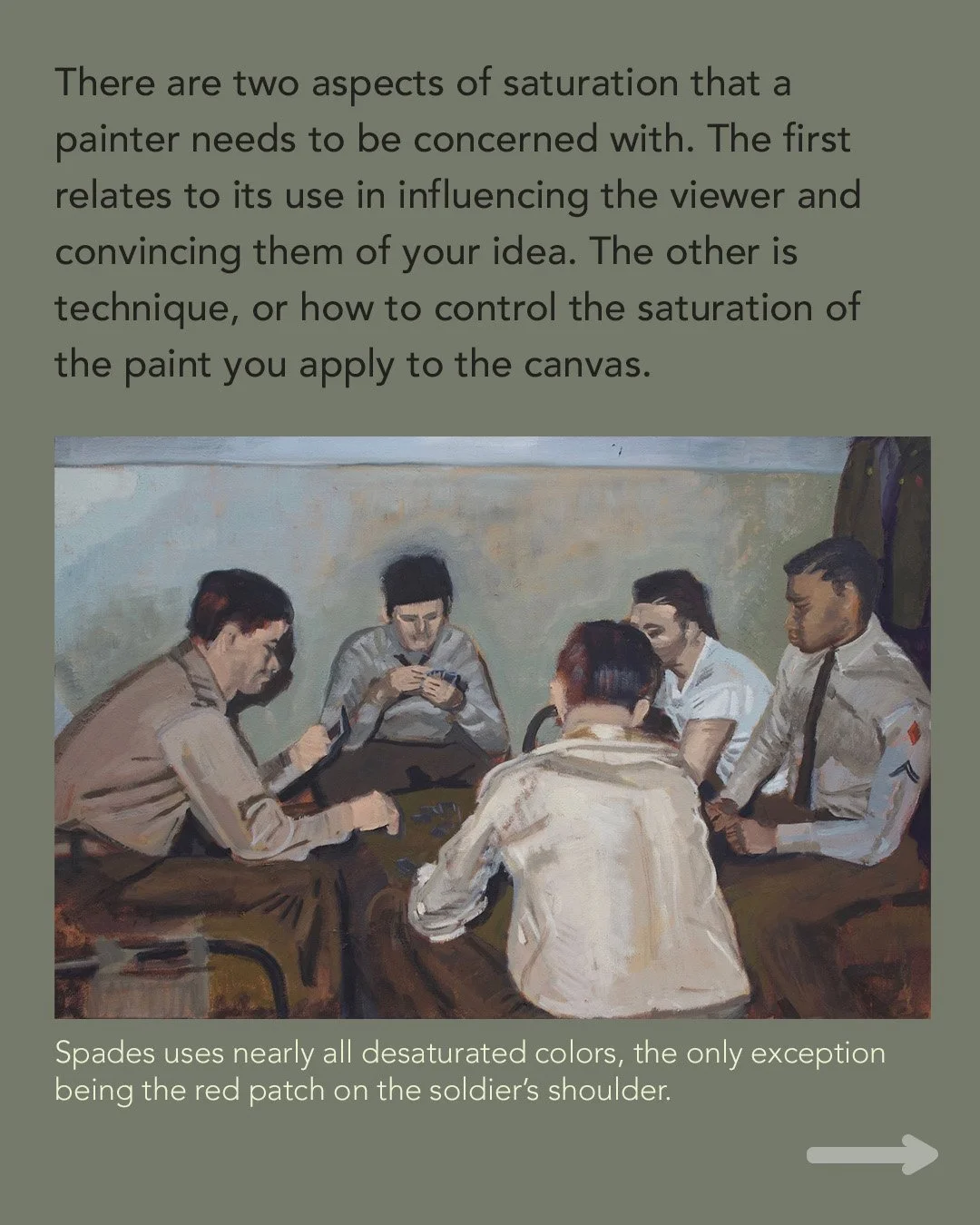
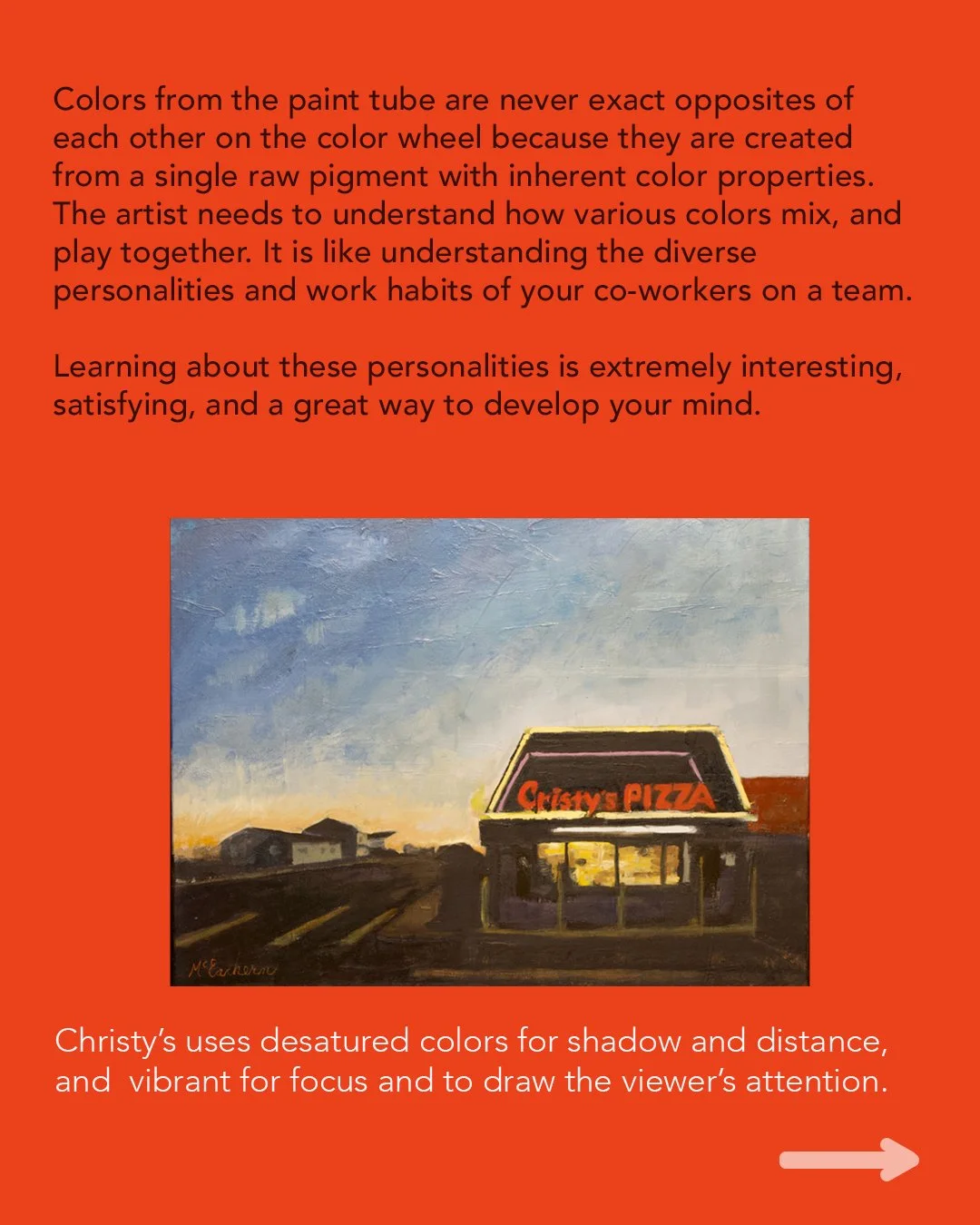
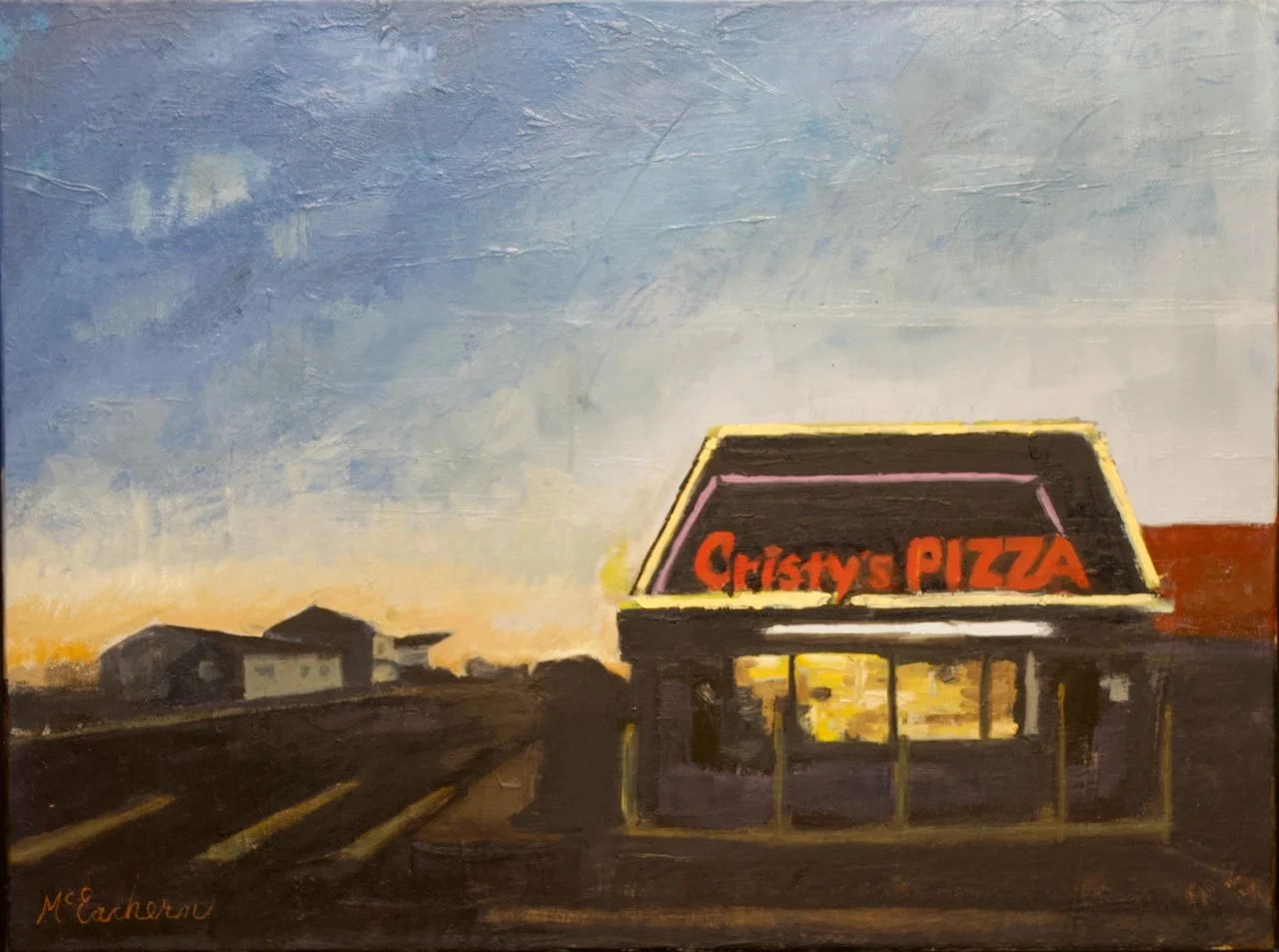
There are two aspects of saturation that a painter needs to consider. The first relates to influencing the viewer and convincing them of your idea. Here, you are always trying to convey structure, depth, and ultimately, tell a story and evoke emotion. To achieve this, manipulating color vibrance across a canvas is one of many tools available. For example, an object you want to be perceived as distant should be less saturated, with less color. Similarly, elements intended to appear in shadow would also be less saturated.

This is not some rule that artists have agreed upon and created. It instead reflects how humans perceive and process color, based on light physics and the way our retinas work. It’s very sophisticated stuff, and the artist needs to find a way to work with ease in this physics framework.

The other important aspect for the artist is technique, or controlling the saturation of paint on the canvas, which is directly tied to color mixing. Paints straight from the tube can be placed on a color wheel by hue, depending on their relationship to the three primary colors.

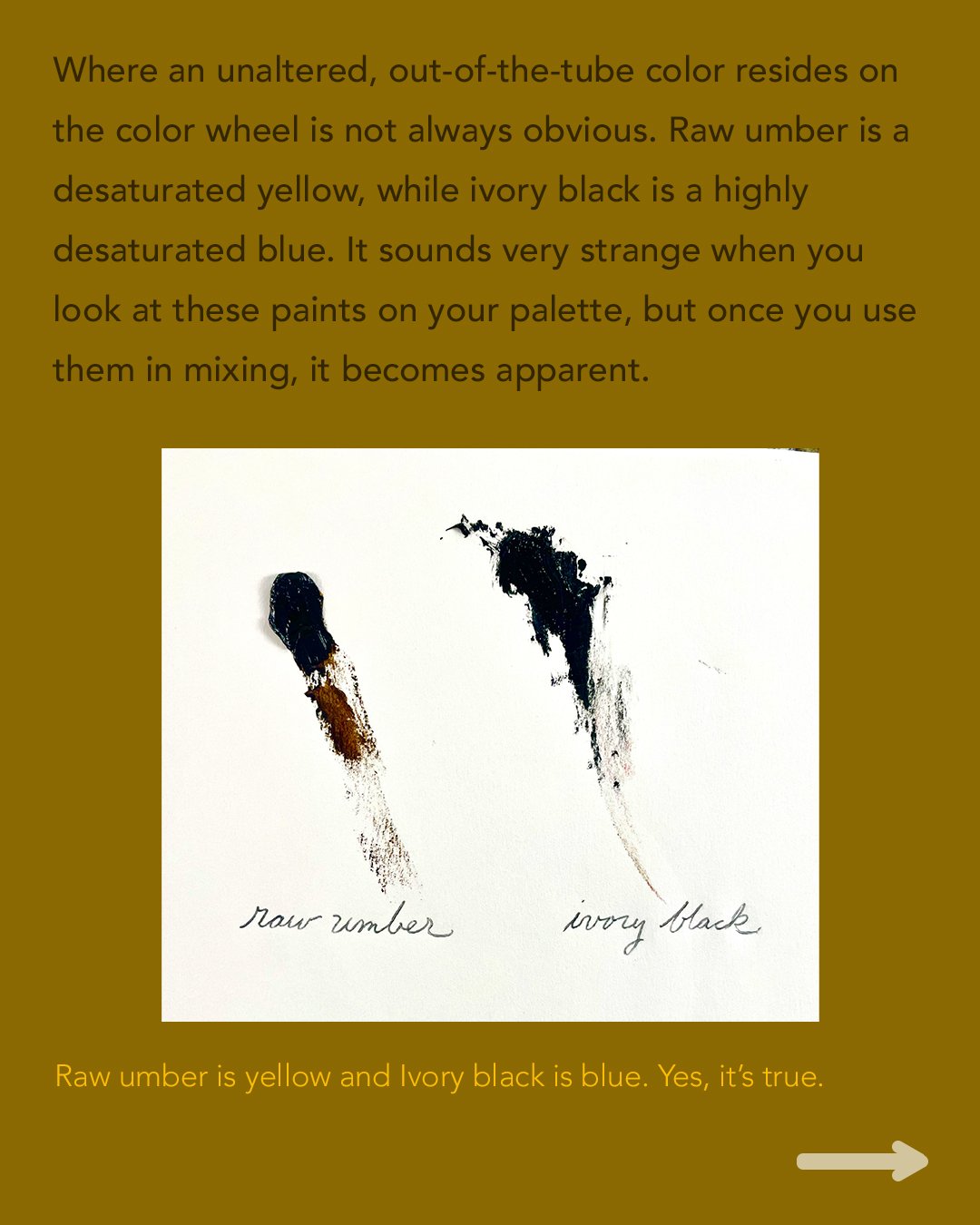
Where an unaltered, out-of-the-tube color resides on the color wheel is not always obvious. Raw umber and ivory black are great examples of this. Raw umber is a desaturated yellow, while ivory black is a highly desaturated blue. It sounds very strange when you look at these paints on your palette, but once you mix them, it becomes apparent.

We all know that blue and yellow mix to create green. If we mix ivory black with a bright yellow, we get a paint mix that is a very murky green, and not really a murky yellow. The blue from the ivory black is making itself known.

Raw umber straight from the tube does not resemble yellow to the untrained eye. It is a dull, uninteresting brown. However, if it is mixed with a bright blue, the yellow will once again be revealed, as the resulting mix is closer to green.

There are two main methods to desaturate a color: add grey, or mix in the complementary color (the one opposite on the color wheel). I generally prefer the complementary method because it produces more visually compelling, dynamic results. To use this approach effectively, you need to precisely identify the color positioning of your paint tubes on the color wheel.

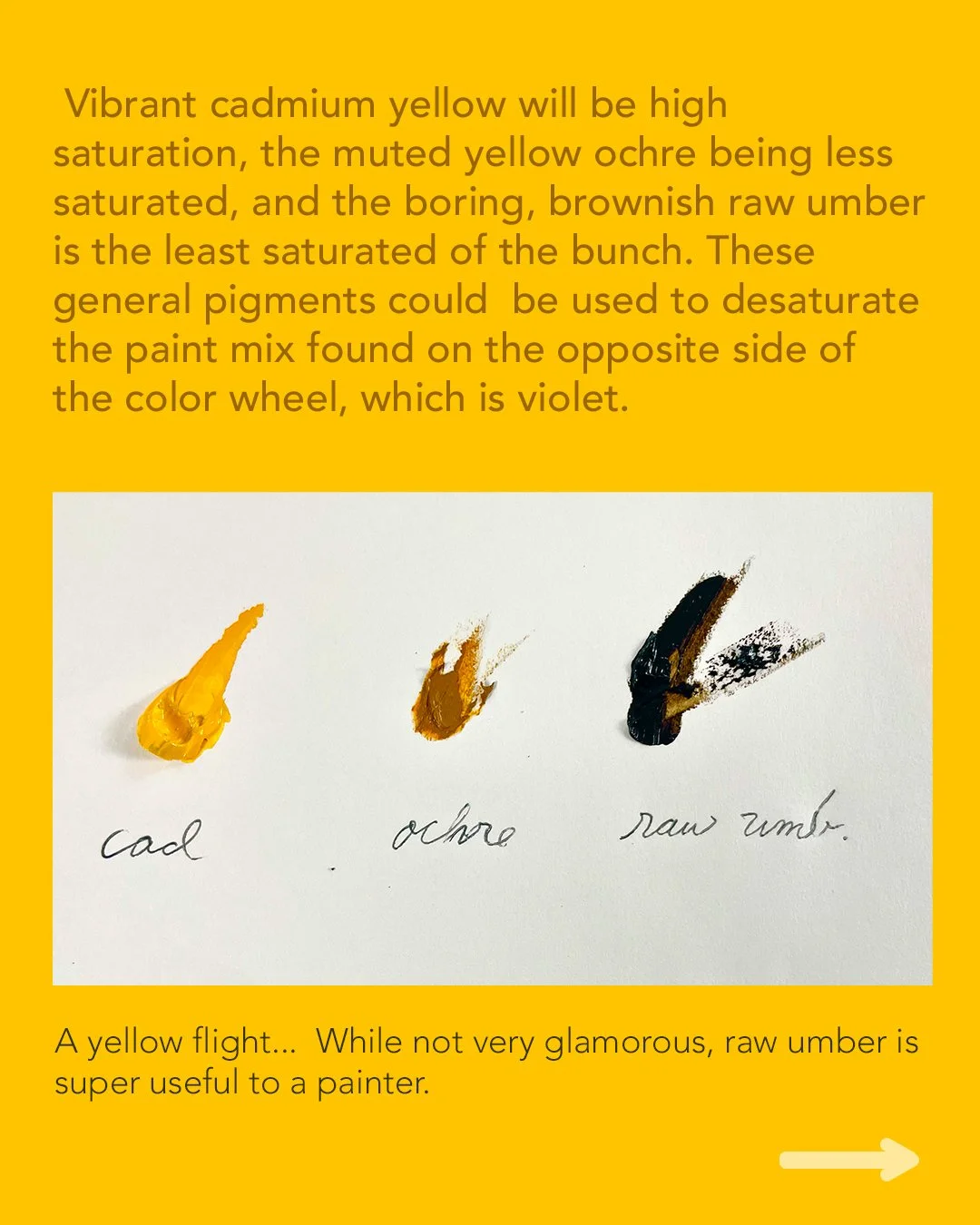
A vibrant cadmium yellow will be high saturation, the muted yellow ochre will be less saturated, and the boring, brownish raw umber is the least saturated of the bunch. These general pigments would be used to desaturate the paint mix found on the opposite side of the color wheel, which is violet. So if there were a purplish object you wanted to convey to the viewer, as in shadow or in the distance, you would consider adding yellow to the mix. The super-powerful raw umber, which seems like Dullsville, is often a great choice for this.

I remember when I was starting out, burnt umber and raw umber were always added to the palette—I thought, 'Ugh, how boring.' Why do these uninteresting colors keep showing up? It’s because they are very effective for pulling out color. You very rarely use paint straight out of the tube—it's too much, and it doesn't reflect our world. You need to pull it back into something more useful and convincing.

Understanding the concept of saturation is straightforward, but the reality, as always in life, is more nuanced. Colors from the paint tube are never exact opposites of each other on the color wheel because they are created from a single raw pigment, which has inherent color properties. Therefore, the artist needs to understand how various colors mix, how they play together, and their strengths. It is like understanding the diverse personalities and work habits of your team members.

Learning about these personalities is extremely interesting, satisfying, and a great way to develop your mind.